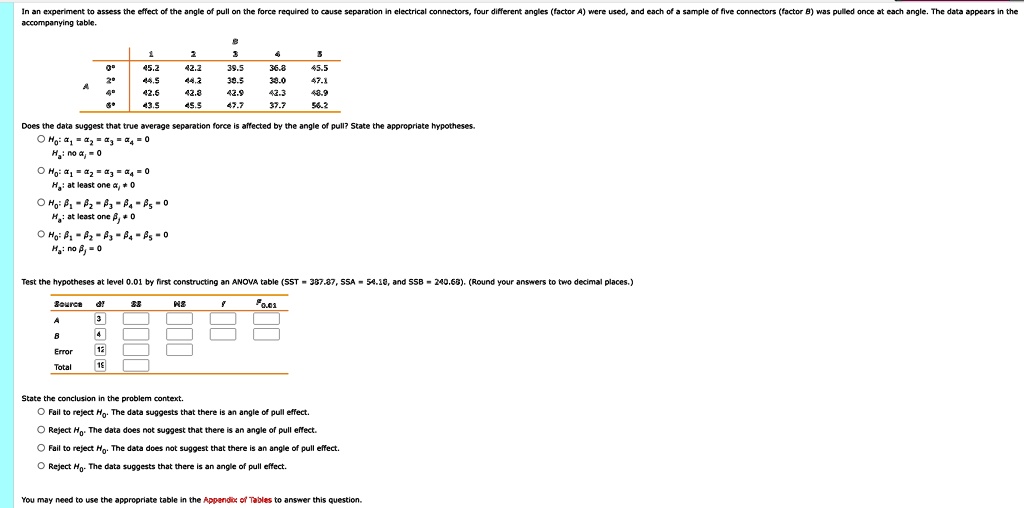
In an experiment to assess the effect of the angle of pull on the force required to cause separation in electrical connectors, four different angles (factor A) were used, and each of a sample of five connectors (factor B) was pulled once at each angle. The data appears in the accompanying table.
1 2 3 4 5
0° 45.2 42.2 39.5 36.8 45.5
2° 44.5 44.2 38.5 38.0 47.1
4° 42.6 42.8 42.9 42.3 48.9
6° 43.5 45.5 47.7 37.7 56.2
Does the data suggest that true average separation force is affected by the angle of pull? State the appropriate hypotheses.
$H_0: \alpha_1 = \alpha_2 = \alpha_3 = \alpha_4 = 0$
$H_a: \text{not all } \alpha_i = 0$
$H_0: \alpha_1 = \alpha_2 = \alpha_3 = \alpha_4 = 0$
$H_a: \text{at least one } \alpha_i \ne 0$
$H_0: \beta_1 = \beta_2 = \beta_3 = \beta_4 = \beta_5 = 0$
$H_a: \text{at least one } \beta_i \ne 0$
$H_0: \beta_1 = \beta_2 = \beta_3 = \beta_4 = \beta_5 = 0$
$H_a: \text{not all } \beta_i = 0$
Test the hypotheses at level 0.01 by first constructing an ANOVA table (SST = 387.87, SSA = 54.18, and SSB = 240.68). (Round your answers to two decimal places.)
Source df SS MS F $F_{0.01}$
A 3
B 4
Error 12
Total 15
State the conclusion in the problem context.
Fail to reject $H_0$. The data suggests that there is an angle of pull effect.
Reject $H_0$. The data does not suggest that there is an angle of pull effect.
Fail to reject $H_0$. The data does not suggest that there is an angle of pull effect.
Reject $H_0$. The data suggests that there is an angle of pull effect.
You may need to use the appropriate table in the Appendix of Tables to answer this question.