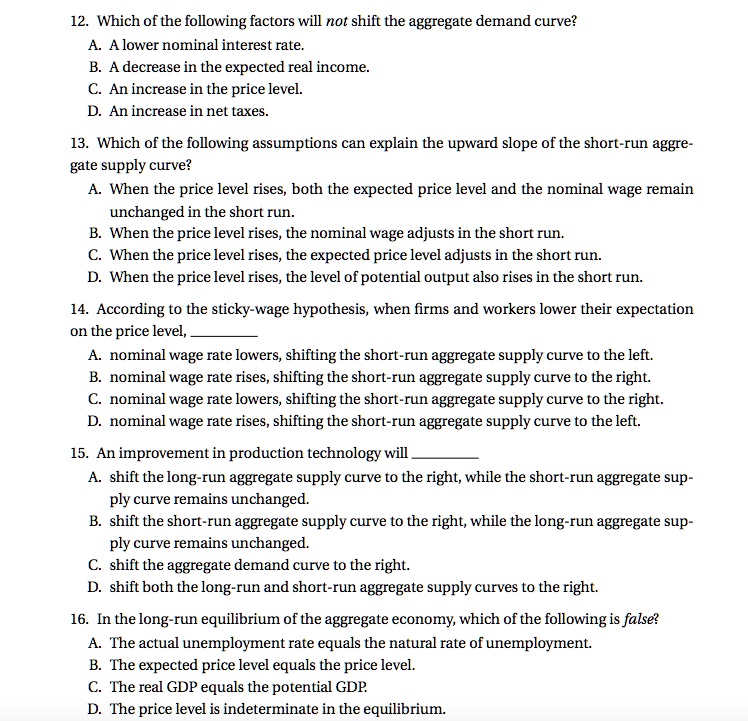
12. Which of the following factors will not shift the aggregate demand curve?
A. A lower nominal interest rate.
B. A decrease in the expected real income.
C. An increase in the price level.
D. An increase in net taxes.
13. Which of the following assumptions can explain the upward slope of the short-run aggre-
gate supply curve?
A. When the price level rises, both the expected price level and the nominal wage remain
unchanged in the short run.
B. When the price level rises, the nominal wage adjusts in the short run.
C. When the price level rises, the expected price level adjusts in the short run.
D. When the price level rises, the level of potential output also rises in the short run.
14. According to the sticky-wage hypothesis, when firms and workers lower their expectation
on the price level,
A. nominal wage rate lowers, shifting the short-run aggregate supply curve to the left.
B. nominal wage rate rises, shifting the short-run aggregate supply curve to the right.
C. nominal wage rate lowers, shifting the short-run aggregate supply curve to the right.
D. nominal wage rate rises, shifting the short-run aggregate supply curve to the left.
15. An improvement in production technology will
A. shift the long-run aggregate supply curve to the right, while the short-run aggregate sup-
ply curve remains unchanged.
B. shift the short-run aggregate supply curve to the right, while the long-run aggregate sup-
ply curve remains unchanged.
C. shift the aggregate demand curve to the right.
D. shift both the long-run and short-run aggregate supply curves to the right.
16. In the long-run equilibrium of the aggregate economy, which of the following is false?
A. The actual unemployment rate equals the natural rate of unemployment.
B. The expected price level equals the price level.
C. The real GDP equals the potential GDP.
D. The price level is indeterminate in the equilibrium.