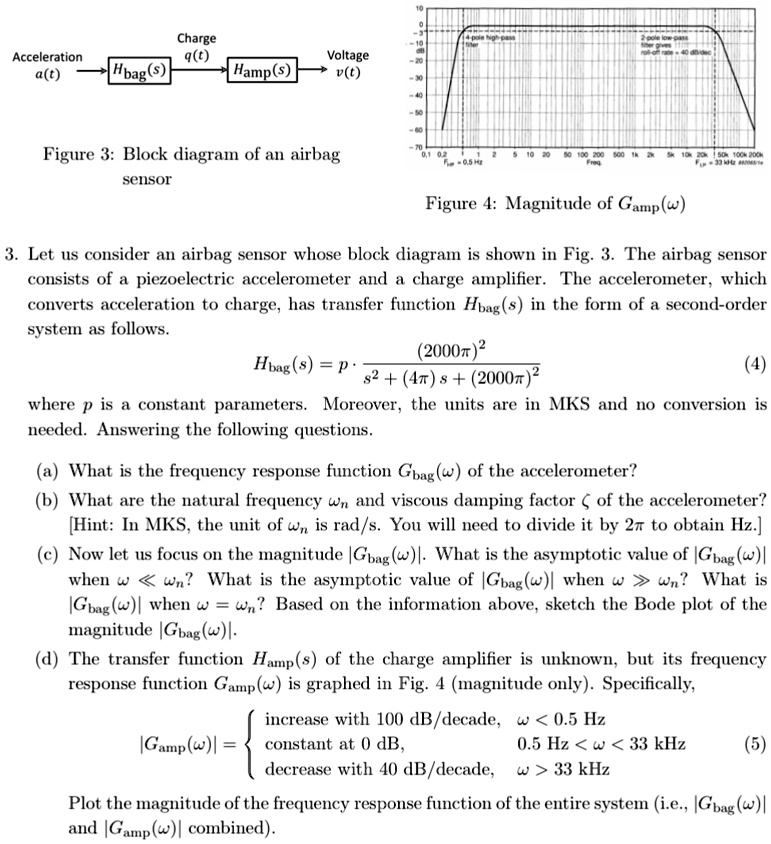
Acceleration
a(t)
Charge
q(t)
Hbag(s)
Hamp(s)
Voltage
v(t)
Figure 3: Block diagram of an airbag
sensor
Figure 4: Magnitude of Gamp (W)
3. Let us consider an airbag sensor whose block diagram is shown in Fig. 3. The airbag sensor
consists of a piezoelectric accelerometer and a charge amplifier. The accelerometer, which
converts acceleration to charge, has transfer function Hbag(s) in the form of a second-order
system as follows.
Hbag(s) = p.
(2000π)2
s2 + (4π) s + (2000π)2
(4)
where p is a constant parameters. Moreover, the units are in MKS and no conversion is
needed. Answering the following questions.
(a) What is the frequency response function Gbag(w) of the accelerometer?
(b) What are the natural frequency wn and viscous damping factor of the accelerometer?
[Hint: In MKS, the unit of wn is rad/s. You will need to divide it by 27 to obtain Hz.]
(c) Now let us focus on the magnitude | Gbag(w). What is the asymptotic value of Gbag (w)|
when w wn? What is the asymptotic value of Gbag(w) when w wn? What is
Gbag(w) when w = wn? Based on the information above, sketch the Bode plot of the
magnitude Gbag(w)|.
(d) The transfer function Hamp(s) of the charge amplifier is unknown, but its frequency
response function Gamp(w) is graphed in Fig. 4 (magnitude only). Specifically,
Gamp(w) =
increase with 100 dB/decade, w < 0.5 Hz
constant at 0 dB,
0.5 Hz <
decrease with 40 dB/decade, ω > 33 kHz
33 kHz
(5)
Plot the magnitude of the frequency response function of the entire system (i.e., Gbag(w)|
and Gamp (w) combined).