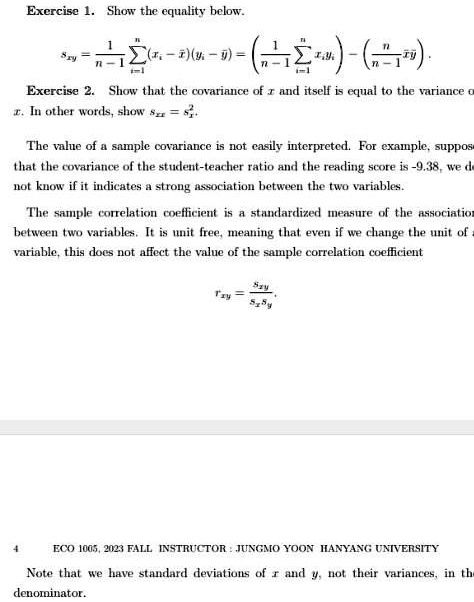
Exercise 1. Show the equality below.
\(s_{xy} = \frac{1}{n-1} \sum_{i=1}^{n} (x_i - \bar{x})(y_i - \bar{y}) = \left(\frac{1}{n-1} \sum_{i=1}^{n} x_iy_i\right) - \left(\frac{n}{n-1}\bar{x}\bar{y}\right)\)
Exercise 2. Show that the covariance of \(x\) and itself is equal to the variance o
f \(x\). In other words, show \(s_{xx} = s_x^2\).
The value of a sample covariance is not easily interpreted. For example, suppos
e that the covariance of the student-teacher ratio and the reading score is -9.38, we do
not know if it indicates a strong association between the two variables.
The sample correlation coefficient is a standardized measure of the association
between two variables. It is unit free, meaning that even if we change the unit of
variable, this does not affect the value of the sample correlation coefficient
\(r_{xy} = \frac{s_{xy}}{s_xs_y}\)
4
ECO 1005, 2023 FALL INSTRUCTOR: JUNGMO YOON HANYANG UNIVERSITY
Note that we have standard deviations of \(x\) and \(y\), not their variances, in the
denominator.