Questions asked
How close does (a) the line 3x − 2y = 4 come to the point (2, 5)? (b) the line y = 5 − 2x come to the point (1, −2)? (c) the circle with radius 3 and center at (2, 3) come to the point (8, 3)?
According to the principles of \_\_\_\_\_ people are relatively likely to repeat behaviors that have been rewarded and relatively unlikely to repeat behaviors that have been punished. classical conditioning operant conditioning vicarious learning effort justification
Damage to Broca's area in the brain may result in which of the following? detailed dreams disruption of language use memory difficulties visuospatial difficulties
Question 5 0.5 pts Excessive depression can be caused by a chemical imbalance in the brain Psychodynamic Cognitive Humanistic Sociocultural Biological Behavioral / Learning
How do programs like Camp Abilities enhance children's physical, emotional, and social development with visual impairments, and what strategies can be implemented in mainstream sports programs to create a more inclusive environment for these children?
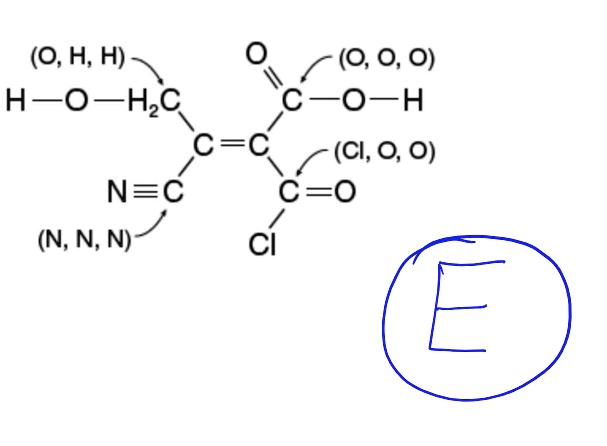
(O, H, H) H-O-H?C N=C (N, N, N) O (O, O, O) C-O-H C=C Cl (Cl, O, O) C=O
Table 15-6 Suppose that a firm in a competitive market faces the following revenues and costs: Quantity Total Revenue Total Cost (Units) (Dollars) (Dollars) 0 0 3 1 6 5 2 12 8 3 18 12 4 24 17 5 30 23 6 36 30 7 42 38 Refer to Table 15-6. The firm should not produce an output level beyond a. 5 units. b. 6 units. c. 7 units. d. 4 units.
At 0.02 to 0.049 BAC, what are some of the effects that alcohol may have on your driving ability. Select all 4 that apply. Pick four answers from below and click Submit.
Solve the system using any method $-x + y + z = -12$, $4x - 3y - z = 35$, $x + y + z = -2$ Your answer is $x = \frac{19}{5}$ $y = -7$ $z = \frac{6}{5}$
You want to establish an account from which you can withdraw $100 weekly for 4 years. The account will invest at 8.7% per year compounded weekly. How large must the account be? Part 1 of 2 Which formula should be used to find how large the account must be? A. $I = Prt$ B. $A = P(1+rt)$ C. $A = P(1+i)^n$, $i = \frac{r}{m}$, $n = mt$ D. $r_{eff} = \left(1 + \frac{r}{m}\right)^m - 1$ E. $r_{eff} = \left(\frac{A}{P}\right)^{1/t} - 1$ F. $S = R\left[\frac{(1+i)^n - 1}{i}\right]$ G. $P = R\left[\frac{1 - (1+i)^{-n}}{i}\right]$