Solution to Eqs. (1) using Cramer's rule
Re-writing the terms in Eqn. (1b) in the proper
order, we get:
$\theta$ = ?($\theta$ + ?x) .. $\theta$ – ?$\theta$ = ??x
Now, we can write Eqs. (1) in matrix form as
follows:
$\begin{bmatrix}\alpha, & \beta \\ \gamma\delta, & 1 - \gamma^2\end{bmatrix}$
Using Cramer's rule, we can solve for x and $\theta$ as
follows:
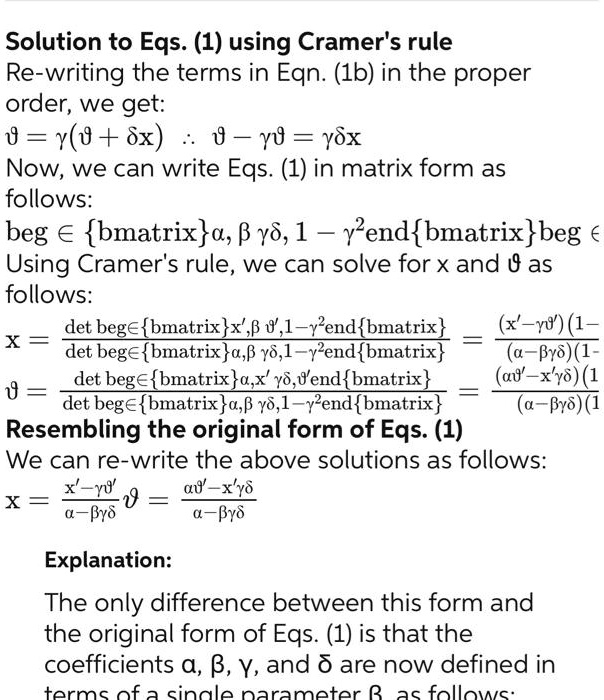
x = \frac{\det \begin{bmatrix}x', & \beta & \\ \theta', & 1-\gamma^2\end{bmatrix}}{\det \begin{bmatrix}\alpha, & \beta \\ \gamma\delta, & 1-\gamma^2\end{bmatrix}} = \frac{(x'-\gamma\theta')(1-\gamma^2)}{(\alpha-\beta\gamma\delta)(1-\gamma^2)}
$\theta$ = \frac{\det \begin{bmatrix}\alpha, & x' \\ \gamma\delta, & \theta'\end{bmatrix}}{\det \begin{bmatrix}\alpha, & \beta \\ \gamma\delta, & 1-\gamma^2\end{bmatrix}} = \frac{(\alpha\theta'-x'\gamma\delta)(1-\gamma^2)}{(\alpha-\beta\gamma\delta)(1-\gamma^2)}
Resembling the original form of Eqs. (1)
We can re-write the above solutions as follows:
x = \frac{x'-\gamma\theta'}{\alpha-\beta\gamma\delta} \quad \theta = \frac{\alpha\theta'-x'\gamma\delta}{\alpha-\beta\gamma\delta}
Explanation:
The only difference between this form and
the original form of Eqs. (1) is that the
coefficients ?, ?, ?, and ? are now defined in
terms of a single parameter ? as follows: