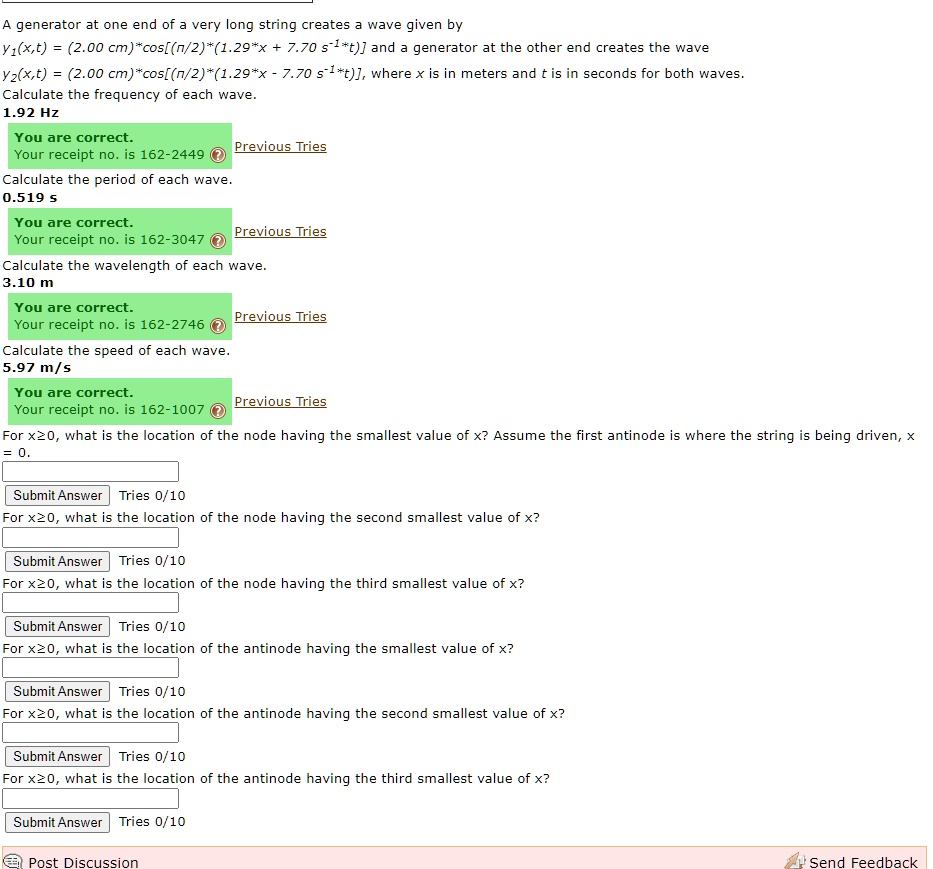
A generator at one end of a very long string creates a wave given by
y1(x,t) = (2.00 cm)*cos[(pi /2)*(1.29*x + 7.70 s-1*t)] and a generator at the other end creates the wave
y2(x,t) = (2.00 cm)*cos[(pi /2)*(1.29*x - 7.70 s-1*t)], where x is in meters and t is in seconds for both waves.
Calculate the frequency of each wave.For x>=0, what is the location of the node having the smallest value of x? Assume the first antinode is where the string is being driven, x = 0.
Tries 0/10
For x>=0, what is the location of the node having the second smallest value of x?
Tries 0/10
For x>=0, what is the location of the node having the third smallest value of x?
Tries 0/10
For x>=0, what is the location of the antinode having the smallest value of x?
Tries 0/10
For x>=0, what is the location of the antinode having the second smallest value of x?
Tries 0/10
For x>=0, what is the location of the antinode having the third smallest value of x?A generator at one end of a very long string creates a wave given by
y_(1)(x,t)=(2.00cm)^(**)cos[((pi )/(2))**(1.29^(**)x+7.70s^(-1**)t)] and a generator at the other end creates the wave
y_(2)(x,t)=(2.00cm)**cos[((pi )/(2))**(1.29^(**)x-7.70s^(-1**t))], where x is in meters and t is in seconds for both waves.
Calculate the frequency of each wave.
1.92Hz
You are correct.
Your receipt no. is 162-2449 (2) Previous Tries
Calculate the period of each wave.
0.519s
You are correct.
You are correct. Your receipt no. is 162-3047 (2) Previous Tries
Calculate the wavelength of each wave.
3.10m
You are correct.
Your receipt no. is 162-2746 (2) Previous Tries
Calculate the speed of each wave.
5.97(m)/(s)
You are correct.
Your receipt no. is 162-1007 (2) Previous Tries
For x>=0, what is the location of the node having the smallest value of x ? Assume the first antinode is where the string is being driven, x
=0.
Submit Answer Tries 0/10
For x>=0, what is the location of the node having the second smallest value of x ?
Submit Answer Tries 0/10
For x>=0, what is the location of the node having the third smallest value of x ?
Submit Answer Tries 0/10
For x>=0, what is the location of the antinode having the smallest value of x ?
Submit Answer Tries 0/10
For x>=0, what is the location of the antinode having the second smallest value of x ?
Submit Answer Tries 0/10
For x>=0, what is the location of the antinode having the third smallest value of x ?
Tries (0)/(10)
A generator at one end of a very long string creates a wave given by Y1(x,t) = (2.00 cm)*cos[(n/2)*(1.29*x + 7.70 s-1*t)] and a generator at the other end creates the wave yz(x,t) = (2.00 cm)*cos[(n/2)*(1.29*x - 7.70 s-1*t)], where x is in meters and t is in seconds for both waves. Calculate the frequency of each wave 1.92 Hz
You are correct. Previous Tries Your receipt no.is 162-2449
Calculate the period of each wave 0.519 s You are correct. Previous Tries Your receipt no.is 162-3047
Calculate the wavelength of each wave. 3.10 m
You are correct. Previous Tries Your receipt no. is 162-2746
Calculate the speed of each wave. 5.97 m/s You are correct. Previous Tries Your receipt no.is 162-1007
For xo, what is the location of the node having the smallest value of x? Assume the first antinode is where the string is being driven, x = 0.
Submit Answer Tries 0/10
For xo, what is the location of the node having the second smallest value of x?
Submit Answer Tries 0/10
For xo, what is the location of the node having the third smallest value of x?
Submit Answer Tries 0/10
For xo, what is the location of the antinode having the smallest value of x?
Submit Answer Tries 0/10
For xo, what is the location of the antinode having the second smallest value of x?
Submit Answer Tries 0/10
For x0, what is the location of the antinode having the third smallest value of x?
Submit Answer Tries 0/10
@Post Discussion
Send Feedback