Problem 1
When sizing motors it is easier to \"reflect\" the inertia of the load to the motor inertia. This avoids
multiple free diagrams used in the previous problem. For a simple 1:1 gear ratio (or direct drive
application) reflecting the inertia is as simple as just adding the individual inertias (load and
motor) together. But when there is a gear ratio involved it's not so simple. For example, adding
the inertias of disk A and B together and multiplying by the acceleration of disk A (4 rad/s^2)
yields a moment of 0.427 lbf-ft; this is incorrect. It's incorrect because the inertia of disk B is
turning slower than the inertia of disk A. A simple proof based on kinetic energy of a rotating
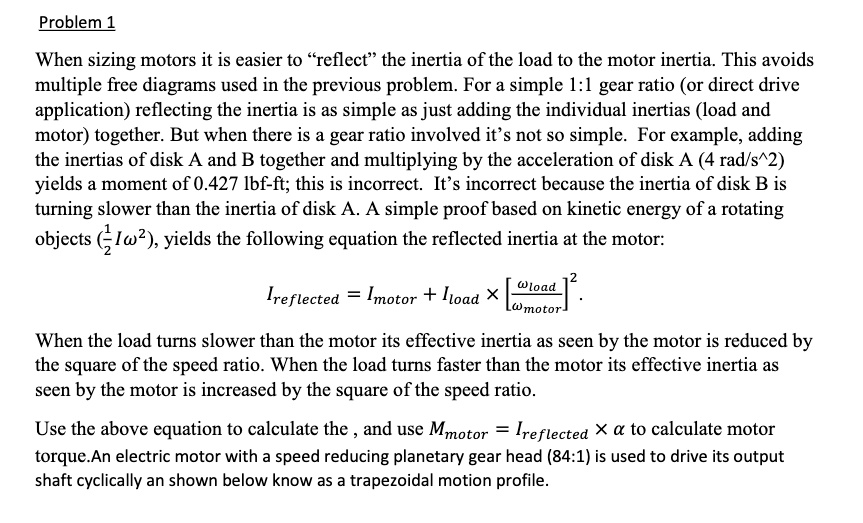
objects ($\frac{1}{2}Iw^2$), yields the following equation the reflected inertia at the motor:
$I_{reflected} = I_{motor} + I_{load} \times \left[\frac{\omega_{load}}{\omega_{motor}}\right]^2$.
When the load turns slower than the motor its effective inertia as seen by the motor is reduced by
the square of the speed ratio. When the load turns faster than the motor its effective inertia as
seen by the motor is increased by the square of the speed ratio.
Use the above equation to calculate the, and use $M_{motor} = I_{reflected} \times \alpha$ to calculate motor
torque. An electric motor with a speed reducing planetary gear head (84:1) is used to drive its output
shaft cyclically an shown below know as a trapezoidal motion profile.