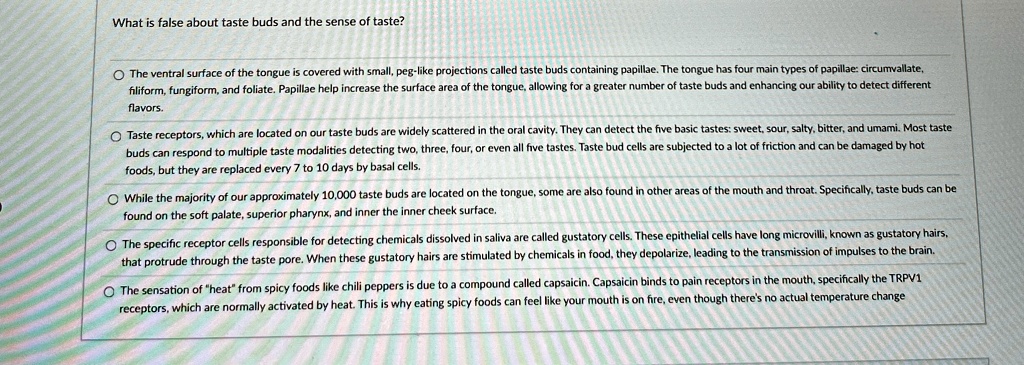
What is false about taste buds and the sense of taste?
The ventral surface of the tongue is covered with small, peg-like projections called taste buds containing papillae. The tongue has four main types of papillae: circumvallate, filiform, fungiform, and foliate. Papillae help increase the surface area of the tongue, allowing for a greater number of taste buds and enhancing our ability to detect different flavors.
Taste receptors, which are located on our taste buds are widely scattered in the oral cavity. They can detect the five basic tastes: sweet, sour, salty, bitter, and umami. Most taste buds can respond to multiple taste modalities detecting two, three, four, or even all five tastes. Taste bud cells are subjected to a lot of friction and can be damaged by hot foods, but they are replaced every 7 to 10 days by basal cells.
While the majority of our approximately 10,000 taste buds are located on the tongue, some are also found in other areas of the mouth and throat. Specifically, taste buds can be found on the soft palate, superior pharynx, and inner the inner cheek surface.
The specific receptor cells responsible for detecting chemicals dissolved in saliva are called gustatory cells. These epithelial cells have long microvilli, known as gustatory hairs, that protrude through the taste pore. When these gustatory hairs are stimulated by chemicals in food, they depolarize, leading to the transmission of impulses to the brain.
The sensation of "heat" from spicy foods like chili peppers is due to a compound called capsaicin. Capsaicin binds to pain receptors in the mouth, specifically the TRPV1 receptors, which are normally activated by heat. This is why eating spicy foods can feel like your mouth is on fire, even though there's no actual temperature change