Ace - AI Tutor
Ask Our Educators
Textbooks
My Library
Flashcards
Scribe - AI Notes
Notes & Exams
Download App
Ishaan patel

Ishaan p.

Divider

Viewed Questions

Suppose you start an antique car by exerting a force of $300 \mathrm{N}$ on its crank for 0.250 s. What is the angular momentum given to the engine if the handle of the crank is $0.300 \mathrm{m}$ from the pivot and the force is exerted to create maximum torque the entire time?

Suppose you start an antique car by exerting a force of $300 \mathrm{N}$ on its crank for 0.250 s. What is the angular momentum given to the engine if the handle of the crank is $0.300 \mathrm{m}$ from the pivot and the force is exerted to create maximum torque the entire time?

University Physics Volume 1

Given the following data for a fire extinguisher-toy wagon rocket experiment, calculate the average exhaust velocity of the gases expelled from the extinguisher. Starting from rest, the final velocity is $10.0 \mathrm{m} / \mathrm{s}$. The total mass is initially $75.0 \mathrm{kg}$ and is $70.0 \mathrm{kg}$ after the extinguisher is fired.

Given the following data for a fire extinguisher-toy wagon rocket experiment, calculate the average exhaust velocity of the gases expelled from the extinguisher. Starting from rest, the final velocity is $10.0 \mathrm{m} / \mathrm{s}$. The total mass is initially $75.0 \mathrm{kg}$ and is $70.0 \mathrm{kg}$ after the extinguisher is fired.

College Physics

Calculate the increase in velocity of a 4000 -kg space probe that expels $3500 \mathrm{kg}$ of its mass at an exhaust velocity of $2.00 \times 10^{3} \mathrm{m} / \mathrm{s} .$ You may assume the gravitational force is negligible at the probe's location.

Calculate the increase in velocity of a 4000 -kg space probe that expels $3500 \mathrm{kg}$ of its mass at an exhaust velocity of $2.00 \times 10^{3} \mathrm{m} / \mathrm{s} .$ You may assume the gravitational force is negligible at the probe's location.

College Physics

A 10.0 -g bullet is fired into a stationary block of wood having mass $m=5.00 \mathrm{kg}$ . The bullet imbeds into the block. The speed of the bullet-plus-wood combination immediately after the collision is 0.600 $\mathrm{m} / \mathrm{s}$ . What was the original speed of the bullet?

A 10.0 -g bullet is fired into a stationary block of wood having mass $m=5.00 \mathrm{kg}$ . The bullet imbeds into the block. The speed of the bullet-plus-wood combination immediately after the collision is 0.600 $\mathrm{m} / \mathrm{s}$ . What was the original speed of the bullet?

Physics for Scientists and Engineers with Modern Physics

Questions asked

INSTANT ANSWER

A force F =(3.75î +(−2.56)ĵ +2.5k̂ )N is applied at a point whose position is r⃗=(−1.9î +3.74ĵ )m. What is the magnitude of the torque, in units of newton meters, generated by this force about the origin?

View Answer
divider
ANSWERED

Timothy James verified

Numerade educator

M m ?

View Answer
divider
ANSWERED

Chasen Shaw verified

Numerade educator

You have a horizontal grindstone (a disk) that is 86 kg, has a 0.38 m radius, is turning at 89 rpm (in the positive direction), and you press a steel axe against the edge with a force of 23 N in the radial direction. Assuming that the kinetic coefficient of friction between steel and stone is 0.20, calculate the angular acceleration of the grindstone in rad/s2. What is the number of turns, N, that the stone will make before coming to rest?

View Answer
divider
ANSWERED

Anand Jangid verified

Numerade educator

A vehicle, starting from rest, accelerates at 2.22m/s2 on a circular track with a 235m diameter. What is the elapsed time, in seconds, at which the centripetal acceleration of the vehicle has the same magnitude as its tangential acceleration?

View Answer
divider
ANSWERED

Supratim Pal verified

Numerade educator

The line which passes through the centers of two small masses, m1 = 441 g and m2 = 403 g, is parallel to the x axis. Initially, mass m2 is at rest, and mass m1 is directed towards it with the velocity ?1,0 = (3.31 m/s)i, as shown. Part (a) What is the x component, in meters per second, of the final velocity of mass m1? Part (b) What is the x component, in meters per second, of the final velocity of mass m2?
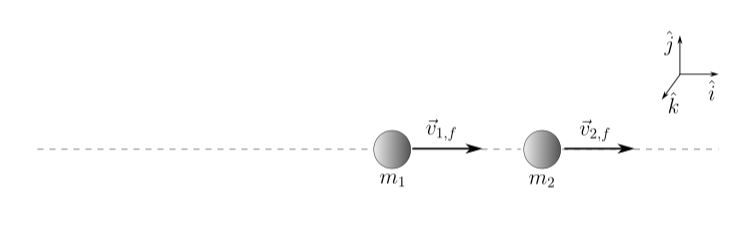
View Answer
divider
ANSWERED

Kenny Mesadieu verified

Numerade educator

F Fmax ?t1 ?t2 t

View Answer
divider
ANSWERED

Kenny Mesadieu verified

Numerade educator

A car of mass m = 1150 kg is traveling down a θ = 12 degree incline. When the car's speed is v0 = 15 m/s, a mechanical failure causes all four of its brakes to lock. The coefficient of kinetic friction between the tires and road is μk = 0.45.Calculate the distance the car travels down the hill L in meters until it comes to a stop at the end.

View Answer
divider