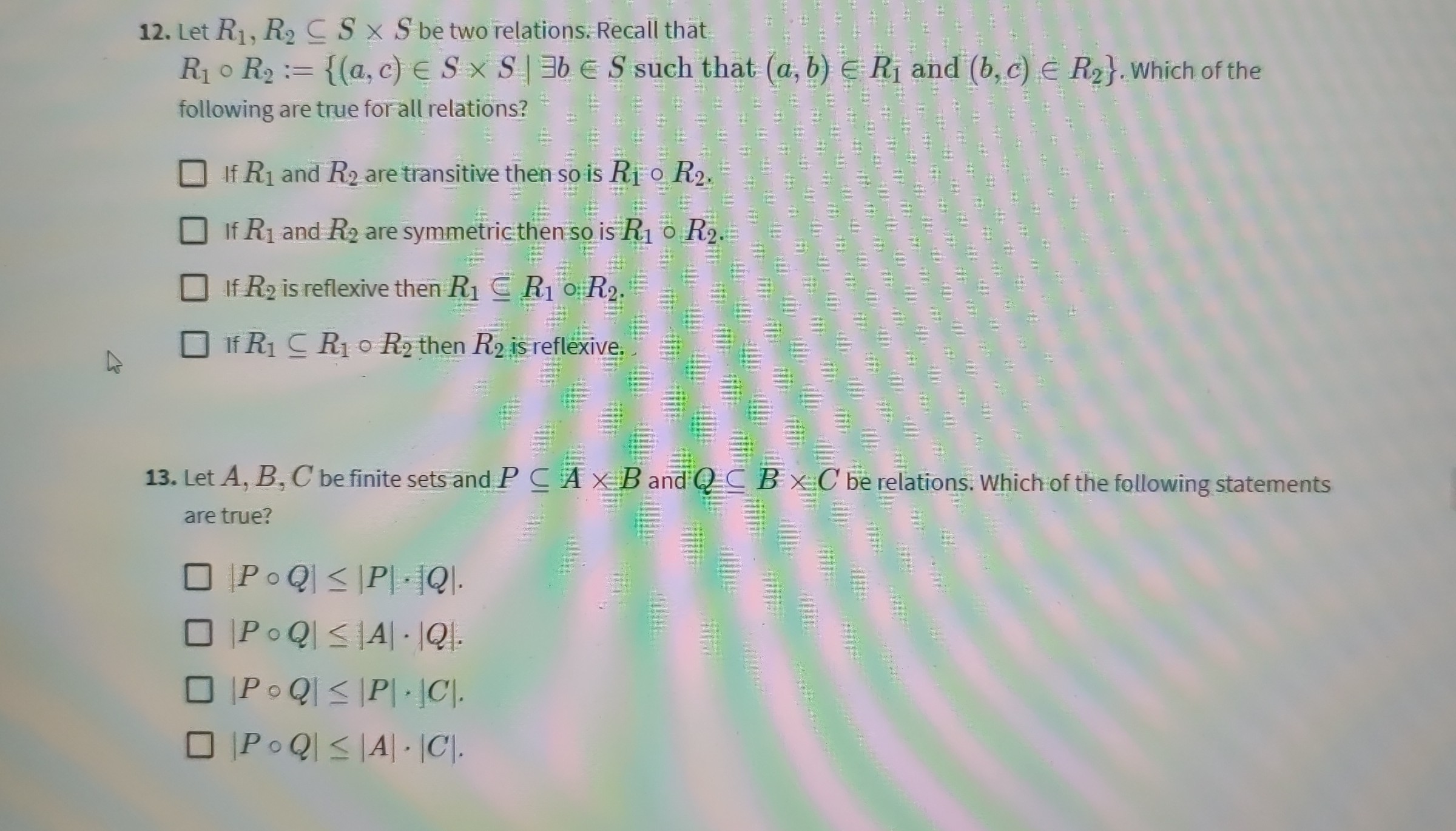
12. Let \( R_{1}, R_{2} \subseteq S \times S \) be two relations. Recall that
\( R_{1} \circ R_{2}:=\left\{(a, c) \in S \times S \mid \exists b \in S\right. \) such that \( (a, b) \in R_{1} \) and \( \left.(b, c) \in R_{2}\right\} \). Which of the following are true for all relations?
If \( R_{1} \) and \( R_{2} \) are transitive then so is \( R_{1} \circ R_{2} \).
If \( R_{1} \) and \( R_{2} \) are symmetric then so is \( R_{1} \circ R_{2} \).
If \( R_{2} \) is reflexive then \( R_{1} \subseteq R_{1} \circ R_{2} \).
If \( R_{1} \subseteq R_{1} \circ R_{2} \) then \( R_{2} \) is reflexive.
13. Let \( A, B, C \) be finite sets and \( P \subseteq A \times B \) and \( Q \subseteq B \times C \) be relations. Which of the following statements are true?
\( |P \circ Q| \leq|P| \cdot|Q| \)
\( |P \circ Q| \leq|A| \cdot|Q| \).
\( |P \circ Q| \leq|P| \cdot|C| \).
\( |P \circ Q| \leq|A| \cdot|C| \).