7. Using a payoff matrix to determine the equilibrium outcome
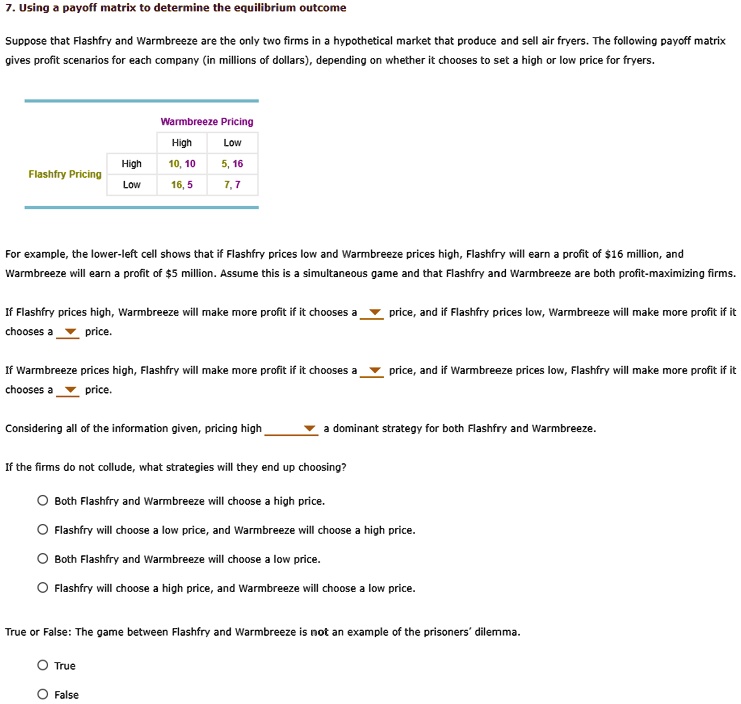
Suppose that Flashfry and Warmbreeze are the only two firms in a hypothetical market that produce and sell air fryers. The following payoff matrix gives profit scenarios for each company (in millions of dollars), depending on whether it chooses to set a high or low price for fryers.
Warmbreeze Pricing
High Low
Flashfry Pricing
High 10, 10 5, 16
Low 16, 5 7, 7
For example, the lower-left cell shows that if Flashfry prices low and Warmbreeze prices high, Flashfry will earn a profit of $16 million, and Warmbreeze will earn a profit of $5 million. Assume this is a simultaneous game and that Flashfry and Warmbreeze are both profit-maximizing firms.
If Flashfry prices high, Warmbreeze will make more profit if it chooses a $\boxed{low}$ price, and if Flashfry prices low, Warmbreeze will make more profit if it chooses a $\boxed{low}$ price.
If Warmbreeze prices high, Flashfry will make more profit if it chooses a $\boxed{low}$ price, and if Warmbreeze prices low, Flashfry will make more profit if it chooses a $\boxed{low}$ price.
Considering all of the information given, pricing high $\boxed{is not}$ a dominant strategy for both Flashfry and Warmbreeze.
If the firms do not collude, what strategies will they end up choosing?
$\bigcirc$ Both Flashfry and Warmbreeze will choose a high price.
$\bigcirc$ Flashfry will choose a low price, and Warmbreeze will choose a high price.
$\bigcirc$ Both Flashfry and Warmbreeze will choose a low price.
$\bigcirc$ Flashfry will choose a high price, and Warmbreeze will choose a low price.
True or False: The game between Flashfry and Warmbreeze is not an example of the prisoners' dilemma.
$\bigcirc$ True
$\bigcirc$ False