22. Which of the following is not a common resource?
a. Elephants in the wild
b. A narrow trail in a public park
c. A vegetable garden
d. Trees in a foerst
23. Suppose buyers of fountain drinks are required to send $1.10 to the government for every fountain drink they buy. Further,
suppose this tax causes the effective price received by sellers of fountain drinks to fall by $0.55 per fountain drink. Which of
the following statements is correct?
a. Forty percent of the burden of the tax falls on buyers.
b. This tax causes the demand curve for fountain drinks to shift downward by $1.10 at each quantity.
c. The price paid by buyers is $0.55 per drink more than it was before the tax.
d. This tax causes the supply curve for fountain drinks to shift downward by $1.10 at each quantity.
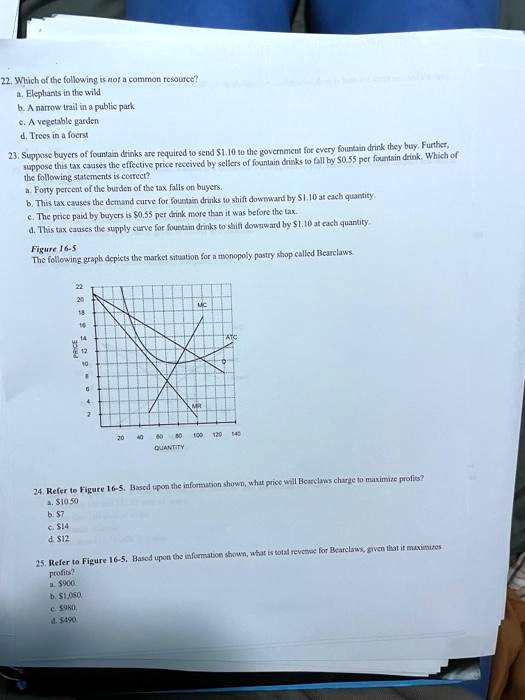
Figure 16-5
The following graph depicts the market situation for a monopoly pastry shop called Bearclaws
PRICE
22
20
18
16
14
12
10
8
6
4
2
0
20
40
60
80
100
120
140
QUANTITY
24. Refer to Figure 16-5. Based upon the information shown, what price will Bearclaws charge to maximize profits?
a. $10.50
b. $7
c. $14
d. $12
25. Refer to Figure 16-5. Based upon the information shown, what is total revenue for Bearclaws, given that it maximizes
profits?
a. $900
b. $1,080
c. $980
d. $490