3)
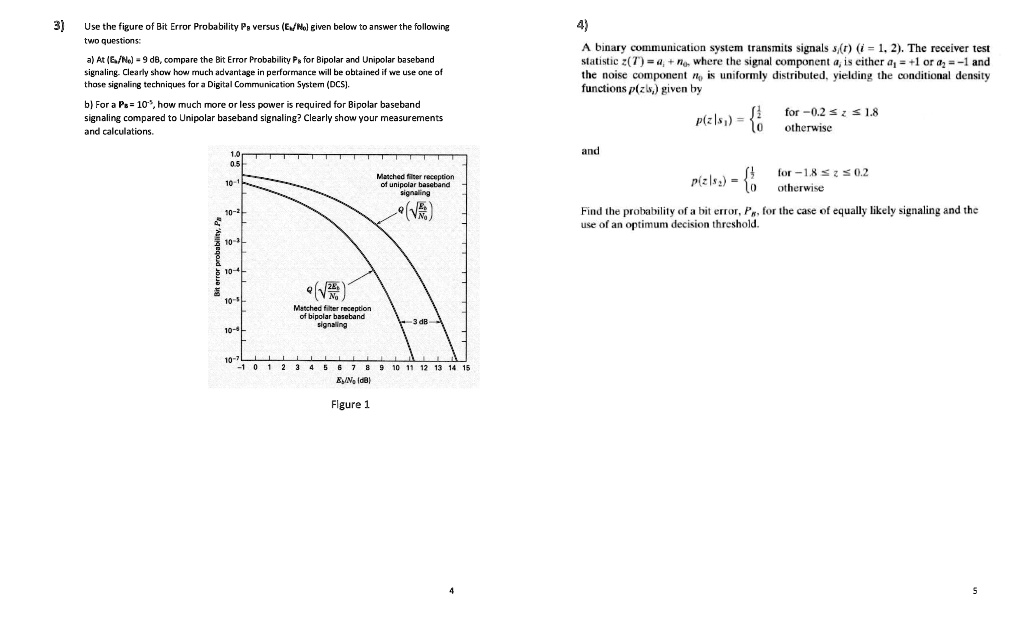
Use the figure of Bit Error Probability $P_b$ versus ($E_b/N_0$) given below to answer the following
two questions:
a) At ($E_b/N_0$) = 9 dB, compare the Bit Error Probability $P_b$ for Bipolar and Unipolar baseband
signaling. Clearly show how much advantage in performance will be obtained if we use one of
those signaling techniques for a Digital Communication System (DCS).
b) For a $P_b = 10^{-5}$, how much more or less power is required for Bipolar baseband
signaling compared to Unipolar baseband signaling? Clearly show your measurements
and calculations.
4)
A binary communication system transmits signals $s_i(t)$ (i = 1, 2). The receiver test
statistic $z(T) = a_i + n_0$, where the signal component $a_i$ is either $a_1 = +1$ or $a_2 = -1$ and
the noise component $n_0$ is uniformly distributed, yielding the conditional density
functions $p(z|s_i)$ given by
$\qquad p(z|s_1) = \begin{cases} \frac{1}{2} & \text{for } -0.2 \le z \le 1.8\\ 0 & \text{otherwise} \end{cases}$
and
$\qquad p(z|s_2) = \begin{cases} \frac{1}{2} & \text{for } -1.8 \le z \le 0.2\\ 0 & \text{otherwise} \end{cases}$
Find the probability of a bit error, $P_b$, for the case of equally likely signaling and the
use of an optimum decision threshold.