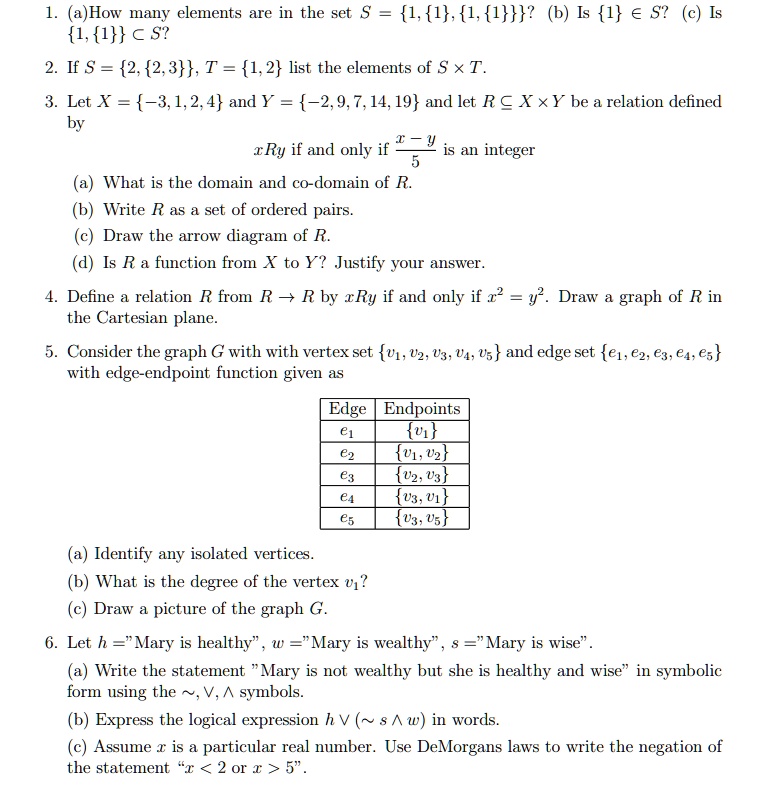
a) How many elements are in the set S = {1, {1}, {1, {1}}}?
b) Is {1} in S?
c) Is {1, {1}} a subset of S?
2. If S = {2, {2, 3}}, T = {1, 2}, list the elements of S x T.
3. Let X = {3, 1, 2, 4} and Y = {2, 9, 7, 14, 19}, and let R be a relation defined by R ⊆ X x Y.
(a) What is the domain and co-domain of R?
(b) Write R as a set of ordered pairs.
(c) Draw the arrow diagram of R.
(d) Is R a function from X to Y? Justify your answer.
4. Define a relation R from â„ to â„ by xRy if and only if x^2 = y^2. Draw a graph of R in the Cartesian plane.
5. Consider the graph G with vertex set {1, V2, 3, 4, 5} and edge set {e1,2, e3, e4, e5} with edge-endpoint function given as:
Edge Endpoints
e1 {v1}
e2 {v1, V2}
e3 {V2, V3}
e4 {V3, v1}
e5 {V3, V5}
(a) Identify any isolated vertices.
(b) What is the degree of the vertex v?
(c) Draw a picture of the graph G.
6. Let h = "Mary is healthy," w = "Mary is wealthy," s = "Mary is wise."
(a) Write the statement "Mary is not wealthy but she is healthy and wise" in symbolic form using the ~, V, A symbols.
(b) Express the logical expression h V (~s A w) in words.
(c) Assume r is a particular real number. Use DeMorgan's laws to write the negation of the statement x < 2 or x > 5.