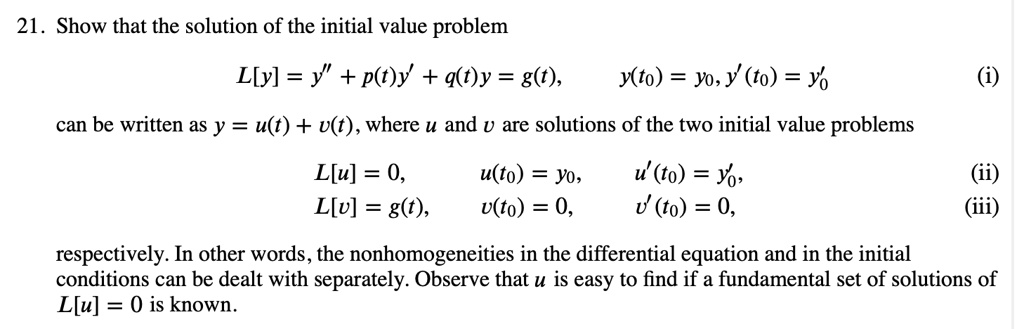
21. Show that the solution of the initial value problem
$L[y] = y'' + p(t)y' + q(t)y = g(t)$,
y($t_0$) = $y_0$, y'($t_0$) = $y_0'$
can be written as y = u(t) + v(t), where u and v are solutions of the two initial value problems
$L[u] = 0$,
$L[v] = g(t)$,
u($t_0$) = $y_0$,
v($t_0$) = 0,
u'($t_0$) = $y_0'$ ,
v'($t_0$) = 0,
(i)
(ii)
(iii)
respectively. In other words, the nonhomogeneities in the differential equation and in the initial
conditions can be dealt with separately. Observe that u is easy to find if a fundamental set of solutions of
$L[u] = 0$ is known.