Please Rework Example Problem 3.1.4.7 in the Technical Handbook for a 10-year return period, an average overland slope of 1%, and a length of overland flow of 110 ft. All other values in the example problem remain the same. Report the peak discharge for the 10-yr design storm in cfs. You can obtain rainfall intensities for the 10-yr storm from here: https://hdsc.nws.noaa.gov/hdsc/pfds/
Thank you!
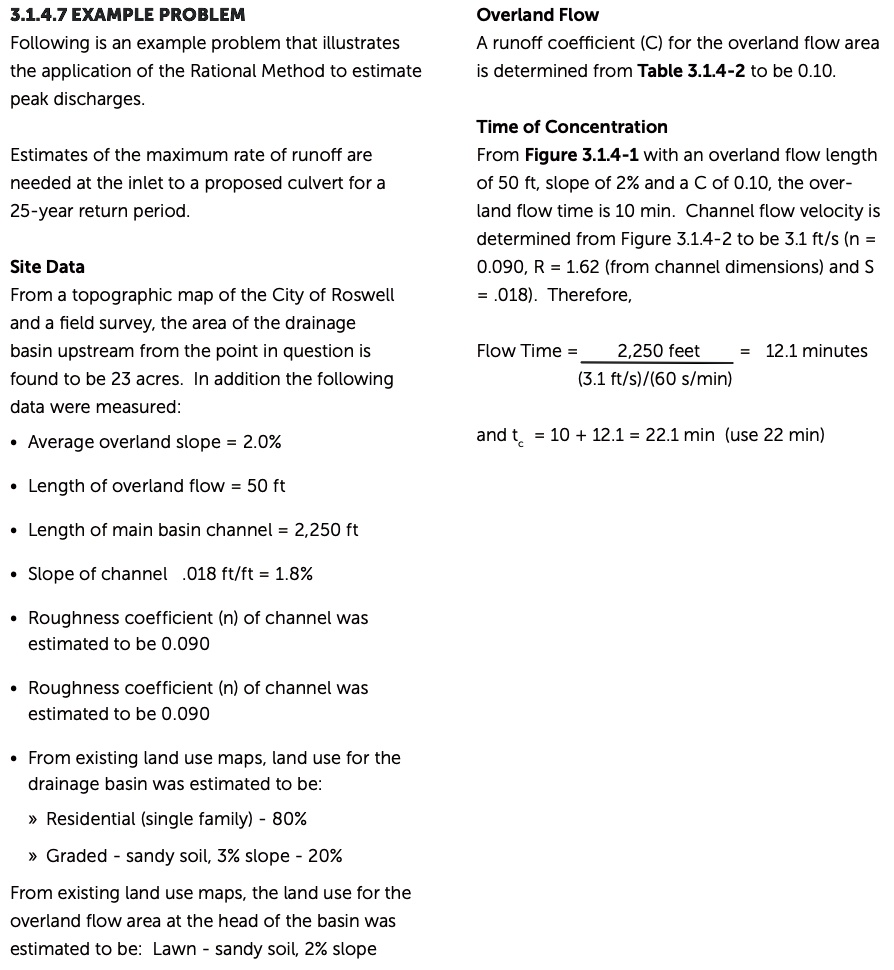
3.1.4.7 EXAMPLE PROBLEM
Overland Flow
Following is an example problem that illustrates the application of the Rational Method to estimate peak discharges for the overland flow area. A runoff coefficient (C) for the overland flow area is determined from Table 3.1.4-2 to be 0.10.
Time of Concentration
Estimates of the maximum rate of runoff are needed at the inlet to a proposed culvert for a 25-year return period. From Figure 3.1.4-1 with an overland flow length of 50 ft, slope of 2%, and a C of 0.10, the overland flow time is 10 min. Channel flow velocity is determined from Figure 3.1.4-2 to be 3.1 ft/s (n = 0.090, R = 1.62 from channel dimensions, and s = 0.018). Therefore, Flow Time = 2,250 feet = 12.1 minutes (3.1 ft/s)/(60 s/min) and t = 10 + 12.1 = 22.1 min (use 22 min).
Site Data
From a topographic map of the City of Roswell and a field survey, the area of the drainage basin upstream from the point in question is found to be 23 acres. In addition, the following data were measured:
- Flow Time = 2,250 feet = 12.1 minutes (3.1 ft/s)/(60 s/min)
- Average overland slope = 2.0%
- Length of overland flow = 50 ft
- Length of main basin channel = 2,250 ft
- Slope of channel = 0.018 ft/ft = 1.8%
- Roughness coefficient (n) of channel was estimated to be 0.090
From existing land use maps, the land use for the drainage basin was estimated to be:
- Residential (single family) - 80%
- Graded - sandy soil, 3% slope - 20%
From existing land use maps, the land use for the overland flow area at the head of the basin was estimated to be: Lawn - sandy soil, 2% slope