Ace - AI Tutor
Ask Our Educators
Textbooks
My Library
Flashcards
Scribe - AI Notes
Notes & Exams
Download App
jacqueline ayala

jacqueline a.

Divider

Questions asked

BEST MATCH

A dc ammeter consists of an Aryton shunt in parallel with a PMMC instrument that has a 1 .4 k coil resistance and 50 A FSD. The Aryton shunt is made up of four 0 .1 series-connected resistors. Calculate the ammeter range at the last contact setting of the shunt. Select one:

View Answer
divider
BEST MATCH

Suppose that the inflation rate is expected to be 1.85% Average Annual Rates Standard Deviation T-Bills Inflation Real T-Bill T-Bills Inflation Real T-Bill Full sample 3.38 1.85 0.46 3.12 4.00 3.76 1927–1951 0.95 1.79 −0.47 1.24 6.04 6.33 1952–2018 4.26 3.46 0.81 3.13 2.89 2.12 (1927-2018)Market Index Big/ Growth Big/ Value Small/ Growth Small/ ValueMean excess return (annualized) 8.29 8.07 11.69 8.99 15.38 Standard deviation (annualized) 18.52 18.35 24.70 26.06 28.21 Suppose that the inflation rate is expected to be 1.85% in the near future using the data provided above, what would be your predictions for the following? (Round your answers to 2 decimal places.)

View Answer
divider
BEST MATCH

What is the scalar projection of the vector (3, -2, 6) on (2, 4, 2)? a) \frac{10}{49} b) \frac{5}{\sqrt{6}} c) \frac{5}{12} d) \frac{10}{7}

View Answer
divider
BEST MATCH

a woman bought large frames for $16 each and some small frames for $8 each. if she bought 26 frames for $272, find how many of ech type she bought

View Answer
divider
BEST MATCH

Exercise 3-41 Algo Observations are drawn from a bell-shaped distribution with a mean of 100 and a standard deviation of 4. a. Approximately what percentage of the observations fall between 92 and 108? Note: Round your answer to the nearest whole percent. Percentage of observations % b. Approximately what percentage of the observations fall between 88 and 112? Note: Round your answer to the nearest whole percent. Percentage of observations % c. Approximately what percentage of the observations are less than 96? Note: Round your answer to 1 decimal place. Percentage of observations %

View Answer
divider
BEST MATCH

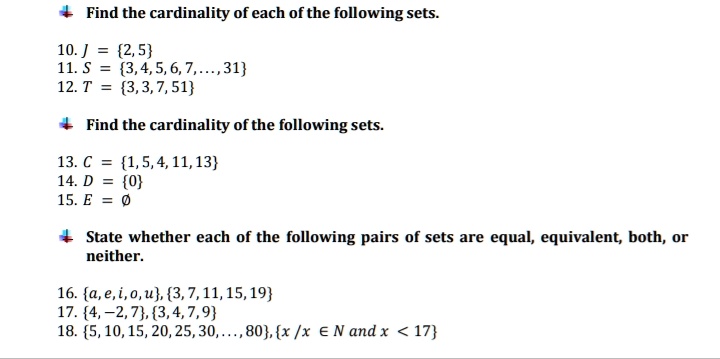
Find the cardinality of each of the following sets. 10. J = {2,5} 11. S = {3,4,5, 6, 7,..., 31} 12. T = {3,3,7, 51} + Find the cardinality of the following sets. 13. C = {1, 5, 4, 11, 13} 14. D = {0} 15. E = Ø State whether each of the following pairs of sets are equal, equivalent, both, or neither. 16. {a, e, i, o, u}, {3, 7, 11, 15, 19} 17. {4, -2, 7}, {3, 4, 7, 9} 18. {5, 10, 15, 20, 25, 30,..., 80}, {x/x ? N and x < 17}
View Answer
divider
BEST MATCH

Assume you have a base-2 computer that stores floating-point numbers using a 6 bit normalized mantissa and a 4 bit exponent, and a sign bit for each. (a) For this machine, what is machine precision? (b) What is the smallest positive normalized number that can be represented in this machine?

View Answer
divider
BEST MATCH

A graphing calculator is recommended. The relative growth rate of world population has been decreasing steadily in recent years. On the basis of this, some population models predict that world population will eventually stabilize at a level that the planet can support. One such logistic model is P(t) = 73.2 / (6.1 + 6.1e^(-0.02t)) where t = 0 is the year 2000 and population is measured in billions. (a) What world population does this model predict for the year 2230? For 2330? (Round your answers to two decimal places.) 2230 billion 2330 billion (b) Sketch a graph of the function P for the years 2000 to 2500. (c) According to this model, what size does the world population seem to approach as time goes on? billion

View Answer
divider
BEST MATCH

For the ideal transformer shown, if n = 5, Ip = 2A, and ZL = 2, find the magnitude of the current IL and the voltage VL. N NS IL + ZL VL

View Answer
divider
BEST MATCH

Part A This photo shows a bobbit worm living in the oceans near Indonesia (Figure 1) Figure <1 of 1 > Does it live in the pelagic zone or the benthic zone? How can you tell? As you can see from the photo, it lives in the water itself, which refers to the pelagic zone. As you can see from the photo, it lives in the water itself, which refers to the benthic zone As you can see from the photo, it lives on the ocean bottom, which refers to the benthic zone As you can see from the photo, it lives on the ocean bottom, which refers to the pelagic zone Submit Request Answer Provide Feedback Ne

View Answer
divider