Ace - AI Tutor
Ask Our Educators
Textbooks
My Library
Flashcards
Scribe - AI Notes
Notes & Exams
Download App
jacqueline rius

jacqueline r.

Divider

Questions asked

BEST MATCH

1. Which gender identity is recognized by some Indigenous cultures in North America and often encompasses a combination of masculine and feminine qualities, along with spiritual significance? O Two-Spirit O Neutrois O Androgynous

View Answer
divider
BEST MATCH

Which of the following statements is most accurate when assessing a patient with depression about suicidal thoughts? Asking a patient about suicide can increase the risk of a suicide attempt. Those with depression will rarely have ideas of death unless they have an actual intent to commit suicide. Hospitalization should be considered for those who express intent to commit suicide. For those who express having a suicide plan, the lethality of the plan provides little indication of suicide risk.

View Answer
divider
BEST MATCH

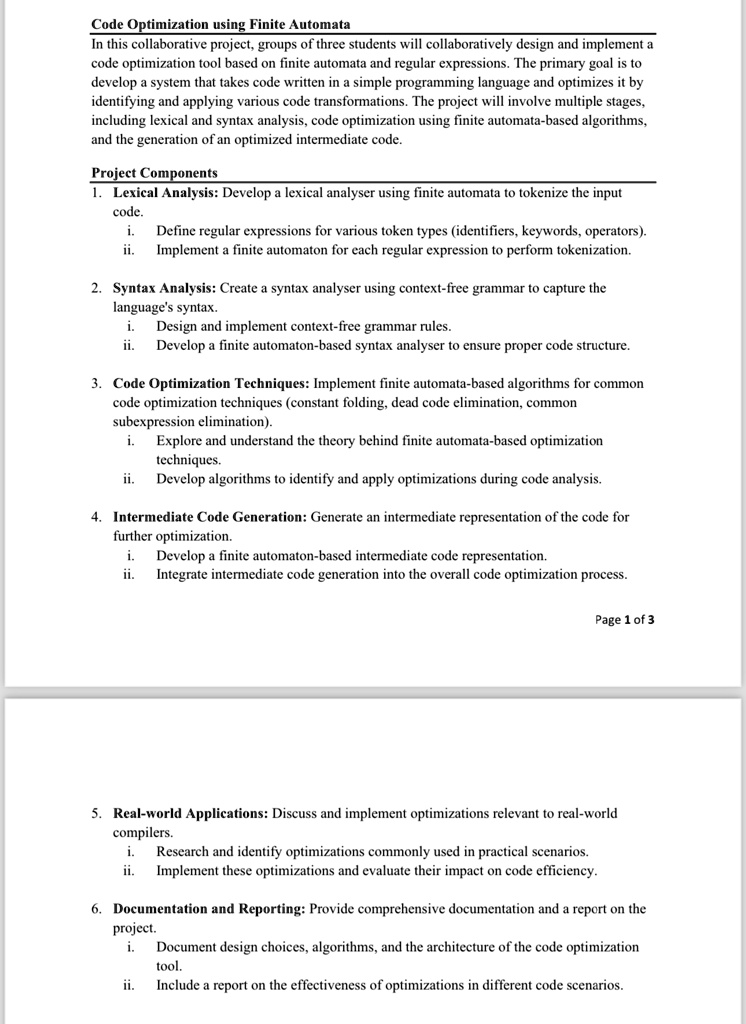
Code Optimization using Finite Automata In this collaborative project, groups of three students will collaboratively design and implement a code optimization tool based on finite automata and regular expressions. The primary goal is to develop a system that takes code written in a simple programming language and optimizes it by identifying and applying various code transformations. The project will involve multiple stages, including lexical and syntax analysis, code optimization using finite automata-based algorithms, and the generation of an optimized intermediate code. Project Components 1. Lexical Analysis: Develop a lexical analyser using finite automata to tokenize the input code. i. Define regular expressions for various token types (identifiers, keywords, operators). ii. Implement a finite automaton for each regular expression to perform tokenization. 2. Syntax Analysis: Create a syntax analyser using context-free grammar to capture the language's syntax. i. Design and implement context-free grammar rules. ii. Develop a finite automaton-based syntax analyser to ensure proper code structure. 3. Code Optimization Techniques: Implement finite automata-based algorithms for common code optimization techniques (constant folding, dead code elimination, common subexpression elimination). i. Explore and understand the theory behind finite automata-based optimization techniques. ii. Develop algorithms to identify and apply optimizations during code analysis. 4. Intermediate Code Generation: Generate an intermediate representation of the code for further optimization. i. Develop a finite automaton-based intermediate code representation. ii. Integrate intermediate code generation into the overall code optimization process. Page 1 of 3 5. Real-world Applications: Discuss and implement optimizations relevant to real-world compilers. i. Research and identify optimizations commonly used in practical scenarios. ii. Implement these optimizations and evaluate their impact on code efficiency. 6. Documentation and Reporting: Provide comprehensive documentation and a report on the project. i. Document design choices, algorithms, and the architecture of the code optimization tool. ii. Include a report on the effectiveness of optimizations in different code scenarios.
View Answer
divider
BEST MATCH

3. When ( phi = 0 ), we get the ARMA(0,1) model which is the MA(1) model. Check whether your solution matches that of Example 3.5 of the textbook. 4. Plot the sample ACFs when ( heta = 0.9 ) and ( phi = 0.6 ) using R for a few lags ( h = 0, 1, 2, 3, 4, 5 ). Check whether they are close to your theoretical derivations.

View Answer
divider
BEST MATCH

Factor the polynomial function $f(x) = 16x^3 + 104x^2 + 125x + 25$. The real zeros are f(x) =

View Answer
divider
BEST MATCH

Who Is Who?: Konrad Lorenz, Harry Harlow, and John Question 2 2 tries left Whose work resulted in the identification of imprinting? Harry Harlow John Bowlby Konrad Lorenz

View Answer
divider
BEST MATCH

I am a little confused about having to do the math calculations for these. Can I get a detailed explanation, please. 1.) Using the allele frequency data from the table, calculate the expected frequency of 24,24 genotype in Hispanic Americans. 2.) Using the allele frequency data from the table, calculate the expected frequency of 18,24 genotype in U.S Caucasians. 3.) Using the allele frequency data from the table, calculate the expected frequency of 18,24 genotype in African Americans. your lab manual and then answer the questions below. Allele Frequency (n=number of alleles typed) Allele U.S. African Americans n=214 Hispanic Americans n=210 0.003 0.003 Allele U.S. African Americans n=214 0.008 Hispanic Americans n=210 0.055 0.058 Caucasians n=200 Caucasians n=200 30 0.008 14 31 0.08 0.048 16 0.048 0.013 0.013 0.005 0.003 17 32 0.238 0.098 0.263 18 0.003 0.005 33 0.01 0.003 0.005 0.003 0.073 0.008 19 34 0.04 0.033 0.02 20 35 0.003 0.115 0.025 21 0.018 36 0.005 0000 0.088 0.028 22 0.03 0.003 0.003 37 0.008 0.008 0.023 23 0.005 0.193 0.318 38 24 0.348 0.023 0.055 39 25 0.04 0.003 0.01 0.008 0.01 40 0.003 26 0.015 0.013 0.008 0.013 41 27 0.05 0.01 0.005 0.063 0.153 >41 0.005 28 0.055 0.055 29 0.053 Table adapted from Klit W., Reynolds R., Chen J., Erlich H.A. 2000). Analysis of genotype frequencies and interlocus association for the PM.DOA1.and pMCT118 loci in four populations. J Forensic Sci. 45(5):1009-15. number of possible genotypic combinations

View Answer
divider
BEST MATCH

I want to clarify the solution to each question within the task separately. (I want the user interface to be drawn in a picture.) I do not want it in writing.

View Answer
divider
BEST MATCH

Explain what is meant by fixed and adaptive learning rates. When should we use the adaptive learning rate? Describe how it works?

View Answer
divider
BEST MATCH

Find the force necessary to compress a spring by 7.9 m if the spring has a spring constant of 5 N/m. Give as a positive number.

View Answer
divider