Ace - AI Tutor
Ask Our Educators
Textbooks
My Library
Flashcards
Scribe - AI Notes
Notes & Exams
Download App
jaime carb-

jaime c.

Divider

Questions asked

BEST MATCH

Conditional probabilities allow you to: make the best use of the law of large numbers work only with mutually exclusive events make use of the information from one event to revise the likelihood of a subsequent event decide which event is most interesting

View Answer
divider
BEST MATCH

A human-capital model suggests what type of people are more likely to migrate from farm to city? Question 7 options: poorer less educated more educated richer

View Answer
divider
BEST MATCH

Question 5 Which of the following infections would be treated with a antihelminthic drug? Pinworms Influenza Cryptosporidiosis Staph infection

View Answer
divider
BEST MATCH

An electric eel develops a potential difference of 480 VV , driving a current of 0.80 AA for a 1.0 msms pulse.

View Answer
divider
BEST MATCH

Verify that \( f^{\prime}(x)=g^{\prime}(x) \). \[ \begin{array}{l} f(x)=\frac{3 x}{x+2}, g(x)=\frac{5 x+4}{x+2} \\ f(x)=\square \\ g(x)=\square \end{array} \] Explain the relationship between \( f \) and \( g \). \( f \) and \( g \) are inverses of each other. \( f \) and \( g \) both have an horizontal asymptotes at \( y=5 \). \( f \) and \( g \) both have an horizontal asymptotes at \( y=3 \). \( f \) and \( g \) are multiples of each other. \( f \) and \( g \) differ by a constant.

View Answer
divider
BEST MATCH

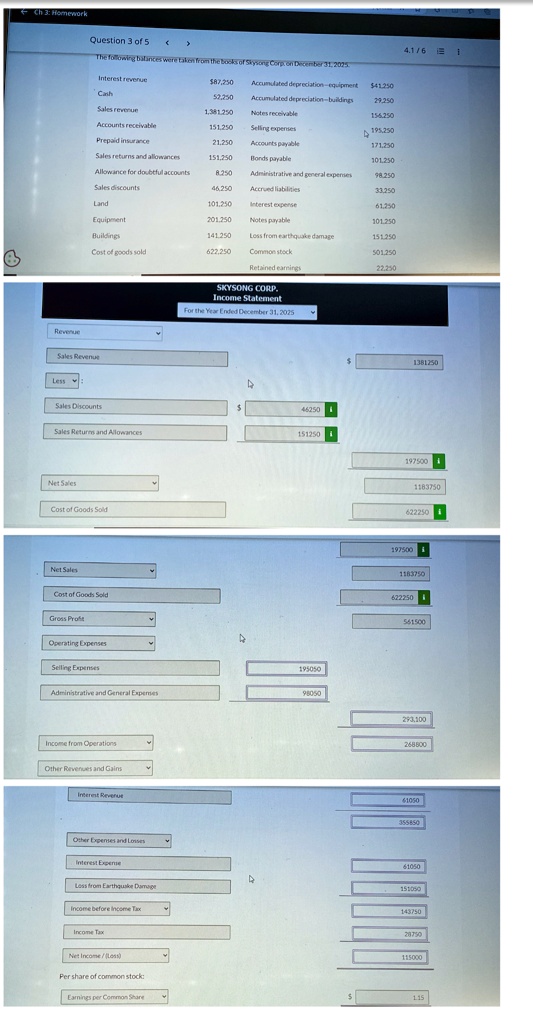
Question 3 of 5 < The following balances were taken from the books of Skysong Corp on December 31, 2025 Interest revenue $87,250 Accumulated depreciation-equipment $41.250 Cash 52,250 Accumulated depreciation-buildings 29,250 Sales revenue 1,381.250 Notes receivable 156.250 Accounts receivable 151,250 Selling expenses 195.250 Prepaid insurance 21,250 Accounts payable 171,250 Sales returns and allowances 151,250 Bonds payable 101.250 Allowance for doubtful accounts 8.250 Administrative and general expenses 98.250 Sales discounts 46,250 Accrued liabilities 33,250 Land 101,250 Interest expense 61,250 Equipment 201.250 Notes payable 101.250 Buildings 141,250 Loss from earthquake damage 151.250 Cost of goods sold 622,250 Common stock 501,250 Retained earnings 22,250 SKYSONG CORP. Income Statement For the Year Ended December 31, 2025 Revenue Sales Revenue Less Sales Discounts Sales Returns and Allowances Net Sales Cost of Goods Sold Net Sales Cost of Goods Sold Gross Profit Operating Expenses Selling Expenses Administrative and General Expenses Income from Operations Other Revenues and Gains Interest Revenue Other Expenses and Losses Interest Expense Loss from Earthquake Damage Income before Income Tax Income Tax Net Income/(Loss) Per share of common stock: Earnings per Common Share 1381250 46250 151250 197500 1183750 622250 197500 1183750 622250 561500 195050 98050 293,100 268800 61050 356850 61050 151250 143750 28750 115000 1.15
View Answer
divider
BEST MATCH

Find the vertex of the following parabola. f(x) = -2x\textsuperscript{2} + 12x - 24 The vertex is \boxed{\text{ (Type an ordered pair.)}}

View Answer
divider
BEST MATCH

Project's description If you used Python programming language, you would unquestionably encounter decorators. This project is about decorators in the R programming language. More precisely, you are to write two example decorators: one printing the execution time of a call and the other providing dynamic scoping for a call. The general syntax of the decorators should look as shown in the following code snippet. decorator %decorator_name% <prefix function call> You are to write two decorators. The first one, called %time_info% should print the time of call execution. An example of the application of this decorator is given in example 1 below. The second decorator, named %dynamic_call%, should provide dynamic scoping for function calls. Example 2 shows the application of this decorator. Example 1 I first define a super slow function to show off how the decorator %time_info% works. f <- function(K = 1) { r <- c() # super inefficient loop for (k in 1:K) { r <- c(r, rnorm(1)) } } The function above implements a super inefficient loop (note the copying). The larger the value of argument k, the longer it takes to finish the loop, and the execution time of the call is longer. Let's see how the decorator works for a simple call and prints the execution time. decorator %time_info% f(10) [1] "Time elapsed: 0.00148105621337891"

View Answer
divider
BEST MATCH

You are given a formula that you are asked to evaluate with given values for the variables. Report your answer rounded to two decimal places. Evaluate the formula $\frac{A - B}{A + B}$ using A = 4.5 and B = 2.1.

View Answer
divider
BEST MATCH

Question 6 Calculate the radius of convergence for the following series. $\sum_{n=1}^{\infty} \frac{nx^n}{n^n}$ $R = 1$ $R = \infty$ $R = 0$ $R = e$ $R = \frac{1}{e}$

View Answer
divider