Ace - AI Tutor
Ask Our Educators
Textbooks
My Library
Flashcards
Scribe - AI Notes
Notes & Exams
Download App
jaime peral

jaime p.

Divider

Questions asked

BEST MATCH

Discuss the underlying causes of food insecurity, such as poverty, lack of access to healthy food, and other systemic issues.

View Answer
divider
BEST MATCH

The members of the Gonzalez family encourage each other to work out differences. They feel comfortable doing so because the parents have made a safe environment to discuss issues and arrive at solutions together. Which optimal communication strategy for strengthening ties is best demonstrated by the Gonzalez family? 1) Share family stories. 2) Have fun together. 3) Negotiate privacy rules. 4) Coach conflict management.

View Answer
divider
BEST MATCH

NPs impact gut microbiota. Cause inflammation. Interfere with the absorption of nutrients. Associated with inflammatory bowel disease, and metabolic disorders. It is an example of the following: Group of answer choices dysbiosis mucosal damage tight junction disruption antibiotic resistance

View Answer
divider
BEST MATCH

Which of these molecular methods will create the MOST full-length duplicates of the original template molecule? Choice 1 of 4:quantitative PCR (q-PCR) Choice 2 of 4:dideoxy Sanger sequencing Choice 3 of 4:MinION (nanopore) DNA sequencing Choice 4 of 4:reverse transcriptase PCR (RT-PCR)

View Answer
divider
BEST MATCH

Treatment for Seasonal affective disorder is: Select one: a. Group therapy b. Psychotherapy c. ECT d. Phototherapy Time left 1:17:

View Answer
divider
BEST MATCH

5. In the equation below, what particle or type of radiation needs to be included to balance the equation.\\ $^{208}Po \rightarrow \text{?} + ^{208}At$

View Answer
divider
BEST MATCH

Find both the vector equation and the parametric equations of the line through (0,0,0) and (3,2,4), where t = 0 corresponds to the first given point. The vector equation is (x,y,z) = \begin{pmatrix} \Box \\ \Box \\ \Box \end{pmatrix} + t\begin{pmatrix} 3\\2\\4 \end{pmatrix}.

View Answer
divider
BEST MATCH

Part A - Titrating Oxalate lon a. Using the volume and known concentration of KMnO_(4) from each successful trial, determine the number of moles of MnO_(4)^(-)required to reach titration endpoint. (Pay attention to units! Recall that molarity always refers to moles per liter.) b. Based on the number of moles of MnO_(4)^(-), determine the number of moles of C_(2)O_(4)^(2-) in each titrated sample. (Refer to the balanced chemical equation and the stoichiometry between these reactants.) c. Determine the mass of C_(2)O_(4)^(-)in each titrated sample. d. Determine the experimental mass percent of C_(2)O_(4)^(-)in each green crystal sample, and find the average of both results. e. Calculate the true mass percent of C_(2)O_(4)^(-)in K_(3)Fe(C_(2)O_(4))_(3)*3H_(2)O based on its molecular formula. Determine your percent error of the average result found in Item d. Part B - Titrating Iron(III) Ion f. Using the volume and known concentration of NaOH, determine the number of moles of OH^(-) required to reach titration endpoint. (Refer to the x,y-coordinates you recorded from your titration plot.) g. Based on the number of moles of OH^(-), determine the number of moles of Fe^(3+) in the titrated sample. (Recall its stoichiometry.) h. Determine the mass of Fe^(3+) in the titrated sample. i. Determine the experimental mass percent of Fe^(3+) in the green crystal sample. j. Calculate the true mass percent of Fe^(3+) in K_(3)Fe(C_(2)O_(4))_(3)*3H_(2)O based on its molecular formula. Determine your percent error of the result found in Item i. I really need help with how to solve this. Please show all your work. The volume of KMnO4 Is .75mL and the concentration is .0111M Part A- Titrating Oxalate lon a.es Recall that molarity always refers to moles per liter.) b. reactants.) C. Determine the mass of C2O4- in each titrated sample d. average of both results. e. Part B - Titrating Iron(III) lon f. required to reach titration endpoint. (Refer to the x,y-coordinates you recorded from your titration plot.) g. Based on the number of moles of OH-, determine the number of moles of Fe3+ in the titrated sample. (Recall its stoichiometry.) h. Determine the mass of Fe3+ in the titrated sample i. Determine the experimental mass percent of Fe3+ in the green crystal sample j. Calculate the true mass percent of Fe3+in KFe(CO433HO based on its molecular formula Determine your percent error of the result found in Item i.

View Answer
divider
BEST MATCH

Penny is a recovering drug addict. Her treatment program emphasizes the influence of her environment-"people, places, and things"-on her use of her drug of choice. Her program reflects the ____ perspective in psychology. a. Humanistic b. Behavioral c. Cognitive d. Psychoanalytic

View Answer
divider
BEST MATCH

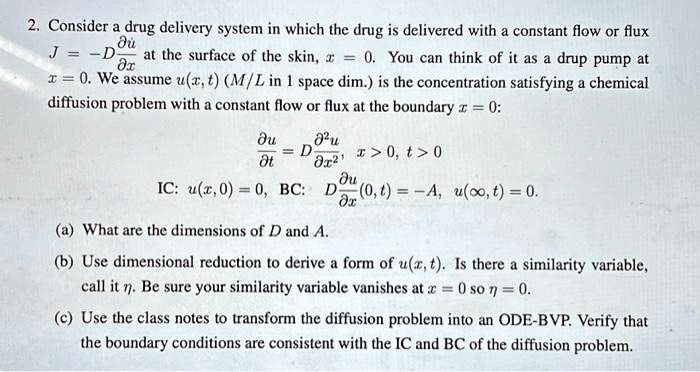
2. Consider a drug delivery system in which the drug is delivered with a constant flow or flux $\frac{\partial u}{\partial x}$ at the surface of the skin, $x = 0$. You can think of it as a drup pump at $x = 0$. We assume $u(x, t)$ ($M/L$ in 1 space dim.) is the concentration satisfying a chemical diffusion problem with a constant flow or flux at the boundary $x = 0$: $\frac{\partial u}{\partial t} = D \frac{\partial^2 u}{\partial x^2}$, $x > 0$, $t > 0$ IC: $u(x, 0) = 0$, BC: $D \frac{\partial u}{\partial x}(0, t) = -A$, $u(\infty, t) = 0$. (a) What are the dimensions of $D$ and $A$. (b) Use dimensional reduction to derive a form of $u(x, t)$. Is there a similarity variable, call it $\eta$. Be sure your similarity variable vanishes at $x = 0$ so $\eta = 0$. (c) Use the class notes to transform the diffusion problem into an ODE-BVP. Verify that the boundary conditions are consistent with the IC and BC of the diffusion problem.
View Answer
divider