1) Inductance - Coaxial cable
A coaxial cable has two surface currents
for a < b.
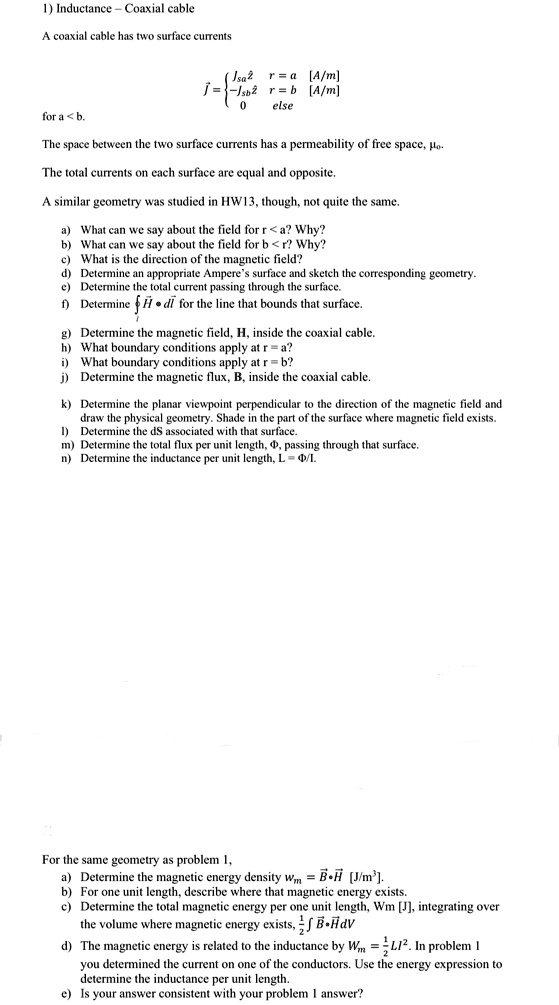
$j = \begin{cases} J_{sa} \frac{a}{r} & r = a \\ -J_{sb} \frac{b}{r} & r = b \\ 0 & \text{else} \end{cases} [A/m]$
The space between the two surface currents has a permeability of free space, $\mu_0$.
The total currents on each surface are equal and opposite.
A similar geometry was studied in HW13, though, not quite the same.
a) What can we say about the field for $r < a$? Why?
b) What can we say about the field for $b < r$? Why?
c) What is the direction of the magnetic field?
d) Determine an appropriate Ampere's surface and sketch the corresponding geometry.
e) Determine the total current passing through the surface.
f) Determine $\oint \vec{H} \cdot d\vec{l}$ for the line that bounds that surface.
g) Determine the magnetic field, H, inside the coaxial cable.
h) What boundary conditions apply at $r = a$?
i) What boundary conditions apply at $r = b$?
j) Determine the magnetic flux, B, inside the coaxial cable.
k) Determine the planar viewpoint perpendicular to the direction of the magnetic field and
draw the physical geometry. Shade in the part of the surface where magnetic field exists.
l) Determine the dS associated with that surface.
m) Determine the total flux per unit length, $\Phi$, passing through that surface.
n) Determine the inductance per unit length, $L = \Phi/I$.
For the same geometry as problem 1,
a) Determine the magnetic energy density $w_m = \vec{B} \cdot \vec{H}$ [J/m³].
b) For one unit length, describe where that magnetic energy exists.
c) Determine the total magnetic energy per one unit length, $W_m$ [J], integrating over
the volume where magnetic energy exists, $\frac{1}{2} \int \vec{B} \cdot \vec{H} dV$
d) The magnetic energy is related to the inductance by $W_m = \frac{1}{2}LI^2$. In problem 1
you determined the current on one of the conductors. Use the energy expression to
determine the inductance per unit length.
e) Is your answer consistent with your problem 1 answer?