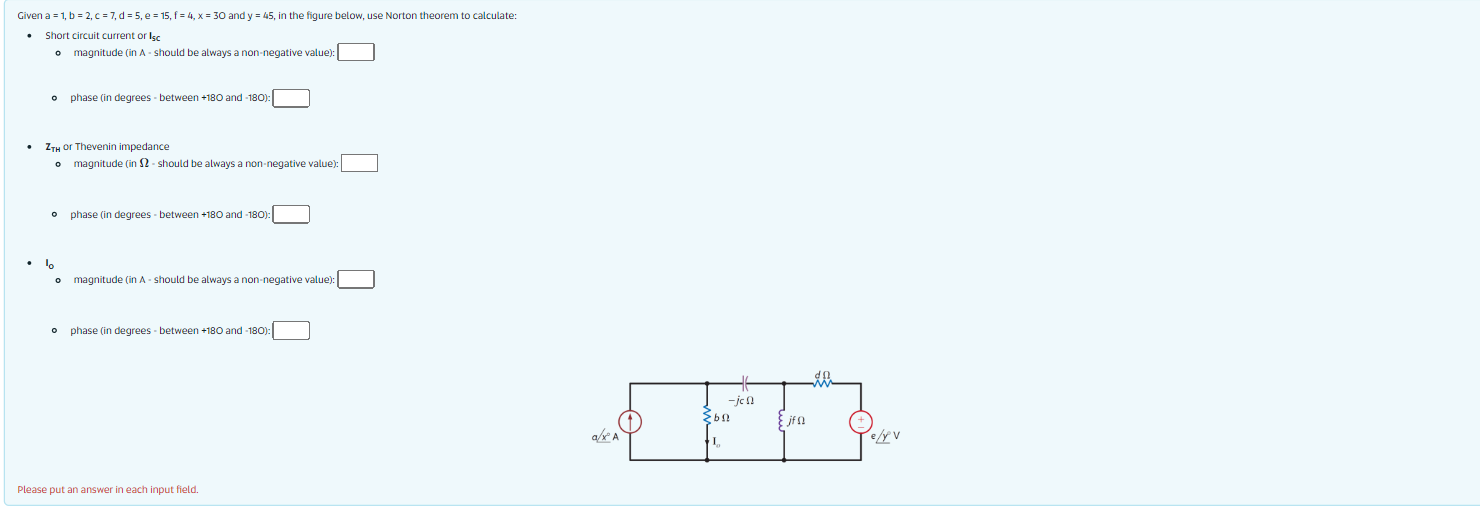
Given \( \mathrm{a}=1, \mathrm{~b}=2, \mathrm{c}=7, \mathrm{~d}=5, \mathrm{e}=15, \mathrm{f}=4, \mathrm{x}=30 \) and \( \mathrm{y}=45 \), in the figure below, use Norton theorem to calculate:
- Short circuit current or \( \mathbf{l}_{\mathbf{s c}} \)
- magnitude (in \( \mathrm{A} \) - should be always a non-negative value):
- phase (in degrees - between +180 and -180):
- \( \mathbf{z}_{\mathrm{TH}} \) or Thevenin impedance
- magnitude (in \( \Omega \) - should be always a non-negative value):
- phase (in degrees - between +180 and -180 ):
- \( \mathrm{I}_{0} \)
- magnitude (in A - should be always a non-negative value):
- phase (in degrees - between +180 and -180): \( \square \)
Please put an answer in each input field.