I have answers that are correct for all these parts, but I just don't really understand why. How does the 2nI+1 rule work? It seems to work for some of question e but not all.
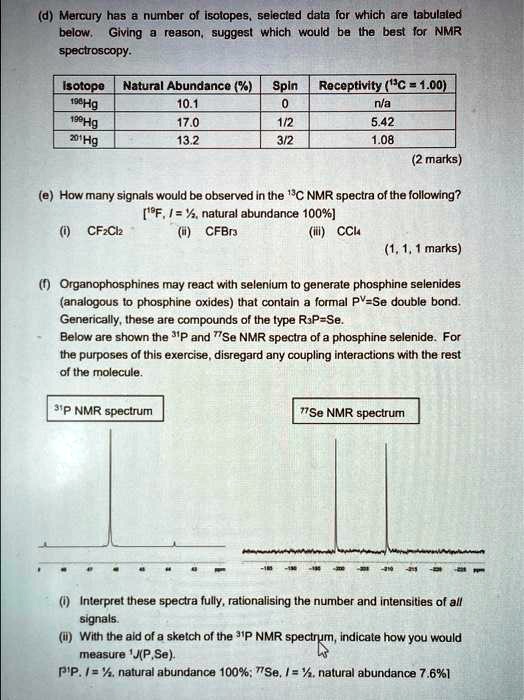
(d) Mercury has a number of isotopes, selected data for which are labeled below. Giving a reason, suggest which would be the best for NMR spectroscopy.
Isotope Natural Abundance (%) 190Hg 10.1 199Hg 17.0 01Hg 13.2
Spin Receptivity C=1.00 0 n/a 1/2 5.42 3/2 1.08 (2 marks)
(e) How many signals would be observed in the 13C NMR spectra of the following [1F. I = natural abundance 100%] (i) CFCI CFBr3 CCI (1,1,1 marks)
(f) Organophosphines may react with selenium to generate phosphine selenides analogous to phosphine oxides that contain a formal pv=Se double bond. Generically, these are compounds of the type RP=Se. Below are shown the 31P and 77Se NMR spectra of a phosphine selenide. For the purposes of this exercise, disregard any coupling interactions with the rest of the molecule.
31P NMR spectrum
77Se NMR spectrum
Interpret these spectra fully, rationalizing the number and intensities of all signals. With the aid of a sketch of the 31P NMR spectrum, indicate how you would measure J(P.Se) (LS pP./=/. natural abundance 100% 77Se. I =/. natural abundance 7.6%1)