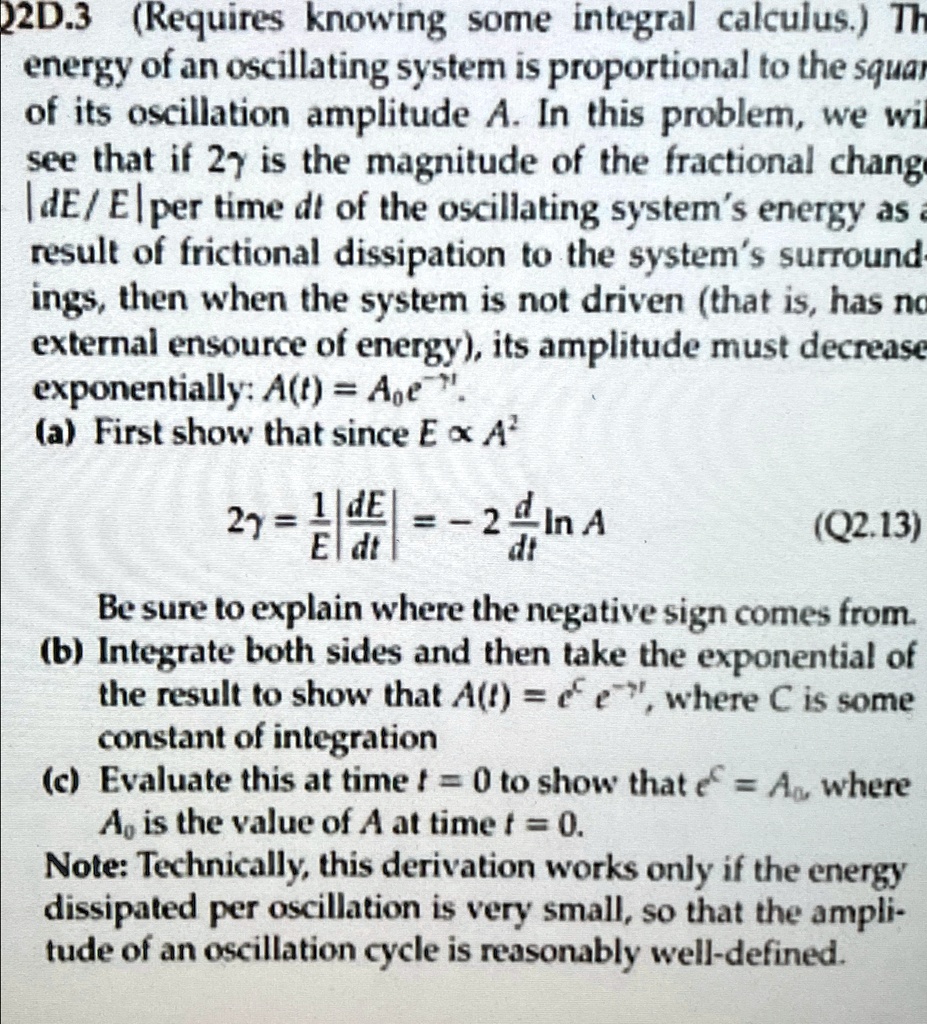
22D.3 (Requires knowing some integral calculus.) The energy of an oscillating system is proportional to the square of its oscillation amplitude A. In this problem, we will see that if 2γ is the magnitude of the fractional change |d(E)/(E)| per time dt of the oscillating system's energy as a result of frictional dissipation to the system's surroundings, then when the system is not driven (that is, has no external energy source), its amplitude must decrease exponentially: A(t) = A₀e^(-2γt).
(a) First show that since E ∝ A^2,
2γ = (1)/(E)|(dE)/(dt)| = -2(d)/(dt)lnA
Be sure to explain where the negative sign comes from.
(b) Integrate both sides and then take the exponential of the result to show that A(t) = e^(C)e^(-2γt), where C is some constant of integration.
(c) Evaluate this at time t = 0 to show that e^(C) = A₀, where A₀ is the value of A at time t = 0.
Note: Technically, this derivation works only if the energy dissipated per oscillation is very small, so that the amplitude of an oscillation cycle is reasonably well-defined.