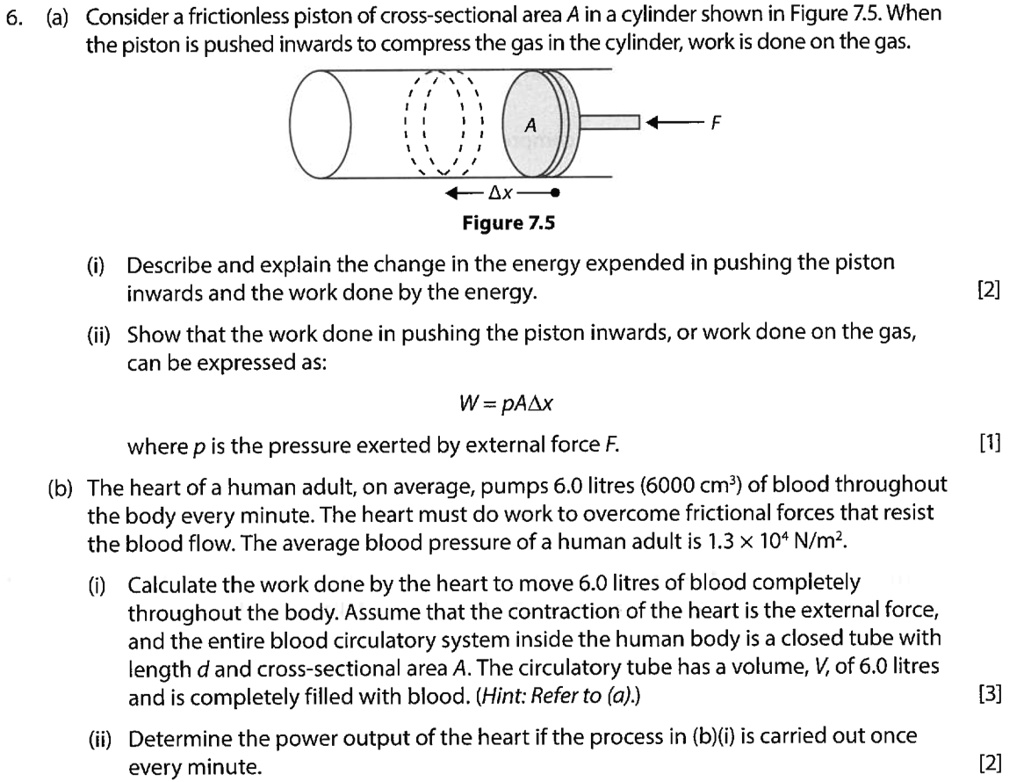
6. (a) Consider a frictionless piston of cross-sectional area A in a cylinder shown in Figure 7.5. When
the piston is pushed inwards to compress the gas in the cylinder, work is done on the gas.
A
F
??
Figure 7.5
(i) Describe and explain the change in the energy expended in pushing the piston
inwards and the work done by the energy.
(ii) Show that the work done in pushing the piston inwards, or work done on the gas,
can be expressed as:
W = pA?x
where p is the pressure exerted by external force F.
(b) The heart of a human adult, on average, pumps 6.0 litres (6000 cm³) of blood throughout
the body every minute. The heart must do work to overcome frictional forces that resist
the blood flow. The average blood pressure of a human adult is 1.3 × 10<sup>4</sup> N/m².
[2]
[1]
(i) Calculate the work done by the heart to move 6.0 litres of blood completely
throughout the body. Assume that the contraction of the heart is the external force,
and the entire blood circulatory system inside the human body is a closed tube with
length d and cross-sectional area A. The circulatory tube has a volume, V, of 6.0 litres
and is completely filled with blood. (Hint: Refer to (a).)
[3]
(ii) Determine the power output of the heart if the process in (b)(i) is carried out once
every minute.
[2]