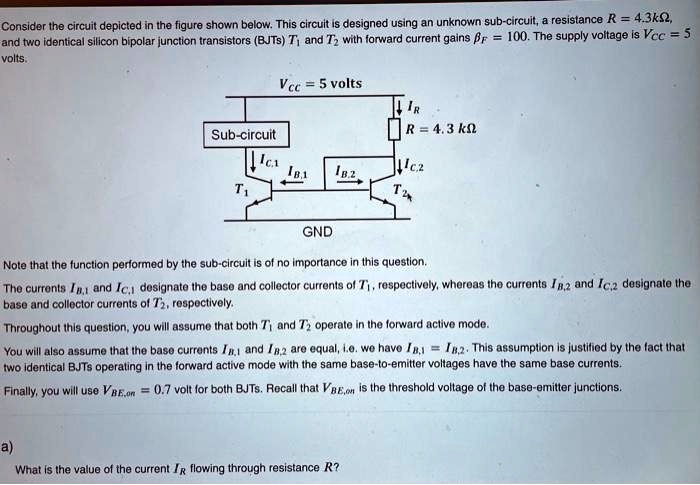
Consider the circuit depicted in the figure shown below. This circuit is designed using an unknown sub-circuit, a resistance R = 4.3k?,
and two identical silicon bipolar junction transistors (BJTs) T? and T? with forward current gains ?f = 100. The supply voltage is Vcc = 5
volts.
Vcc = 5 volts
IR
R = 4.3 k?
Sub-circuit
Ic,1
Ic,2
Ib,1
Ib,2
T1
T2
GND
Note that the function performed by the sub-circuit is of no importance in this question.
The currents Ib,1 and Ic,1 designate the base and collector currents of T?, respectively, whereas the currents Ib,2 and Ic,2 designate the
base and collector currents of T?, respectively.
Throughout this question, you will assume that both T? and T? operate in the forward active mode.
You will also assume that the base currents Ib,1 and Ib,2 are equal, i.e. we have Ib,1 = Ib,2. This assumption is justified by the fact that
two identical BJTs operating in the forward active mode with the same base-to-emitter voltages have the same base currents.
Finally, you will use VBE,on = 0.7 volt for both BJTs. Recall that VBE,on is the threshold voltage of the base-emitter junctions.
a)
What is the value of the current IR flowing through resistance R?