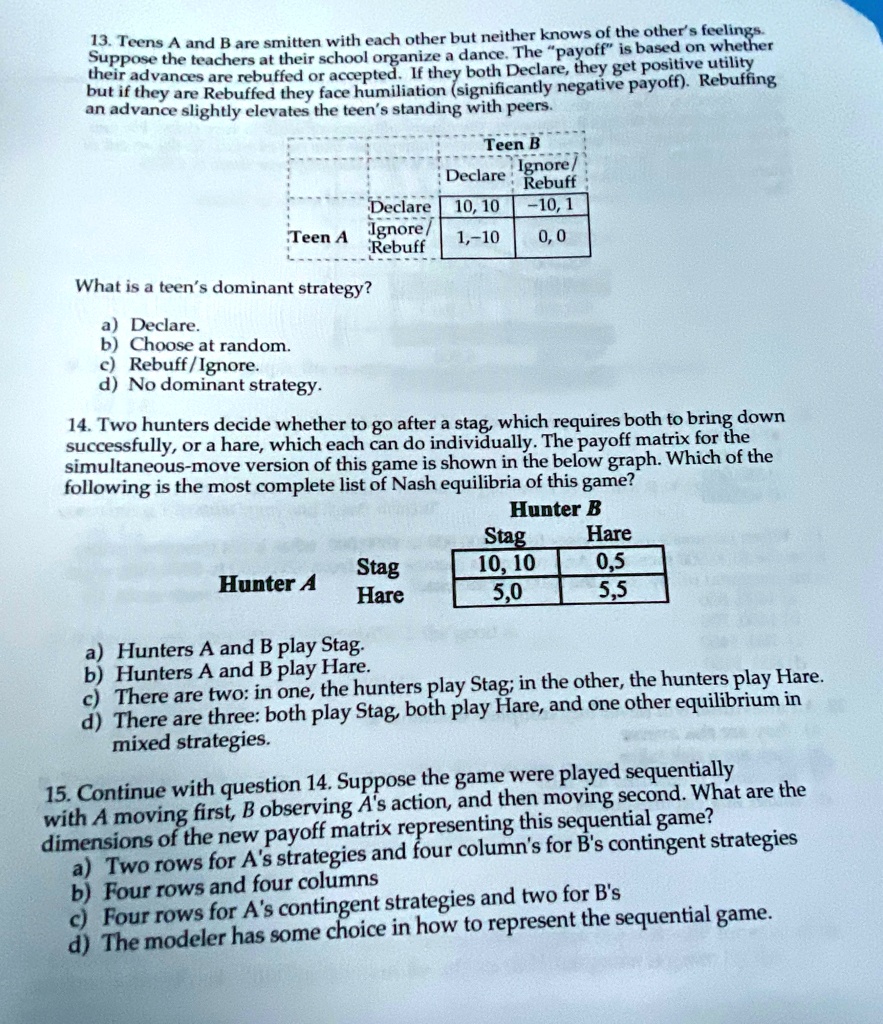
13. Teens A and B are smitten with each other but neither knows of the other's feelings. Suppose the teachers at their school organize a dance. The "payoff" is based on whether their advances are rebuffed or accepted. If they both Declare, they get positive utility but if they are Rebuffed they face humiliation (significantly negative payoff). Rebuffing an advance slightly elevates the teen's standing with peers.
Teen B
Declare Ignore/Rebuff
Declare 10, 10 -10, 1
Teen A
Ignore/Rebuff 1,-10 0,0
What is a teen's dominant strategy?
a) Declare.
b) Choose at random.
c) Rebuff/Ignore.
d) No dominant strategy.
14. Two hunters decide whether to go after a stag, which requires both to bring down successfully, or a hare, which each can do individually. The payoff matrix for the simultaneous-move version of this game is shown in the below graph. Which of the following is the most complete list of Nash equilibria of this game?
Hunter B
Stag Hare
Hunter A
Stag 10, 10 0, 5
Hare 5, 0 5, 5
a) Hunters A and B play Stag.
b) Hunters A and B play Hare.
c) There are two: in one, the hunters play Stag; in the other, the hunters play Hare.
d) There are three: both play Stag, both play Hare, and one other equilibrium in mixed strategies.
15. Continue with question 14. Suppose the game were played sequentially with A moving first, B observing A's action, and then moving second. What are the dimensions of the new payoff matrix representing this sequential game?
a) Two rows for A's strategies and four column's for B's contingent strategies
b) Four rows and four columns
c) Four rows for A's contingent strategies and two for B's
d) The modeler has some choice in how to represent the sequential game.