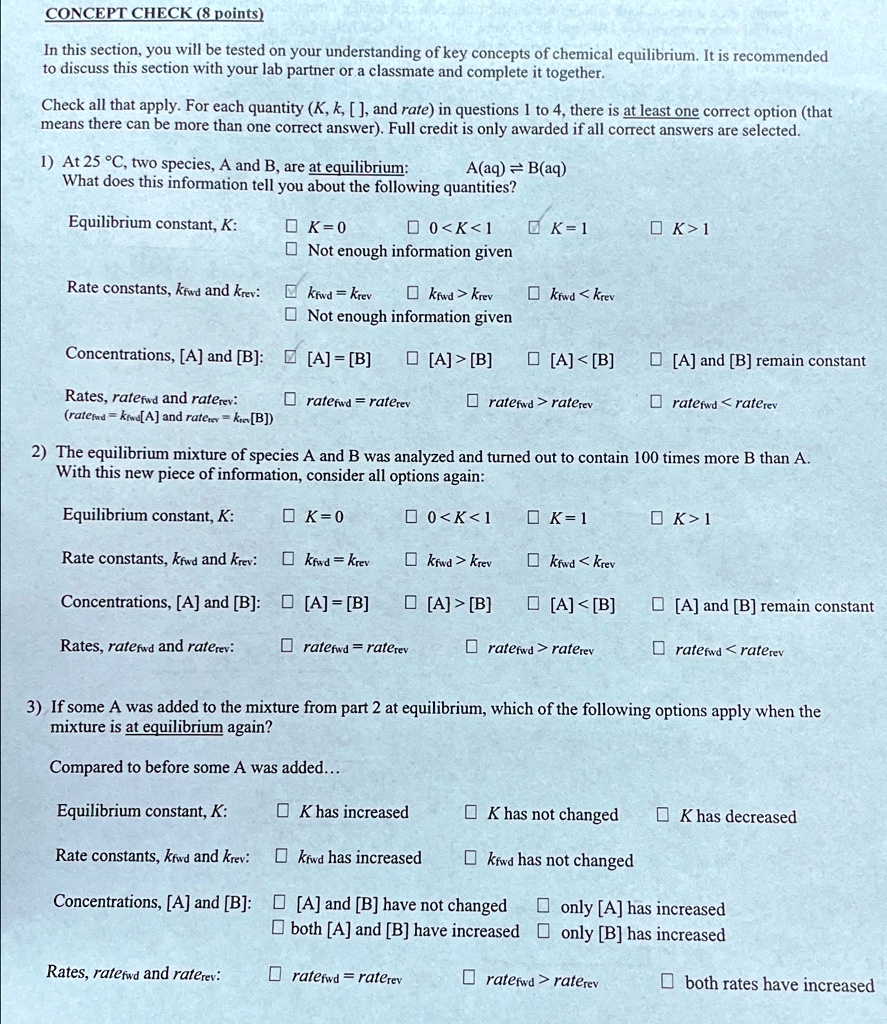
CONCEPT CHECK (8 points)
In this section, you will be tested on your understanding of key concepts of chemical equilibrium. It is recommended to discuss this section with your lab partner or a classmate and complete it together.
Check all that apply. For each quantity (K, k, [], and rate) in questions 1 to 4, there is at least one correct option (that means there can be more than one correct answer). Full credit is only awarded if all correct answers are selected.
1) At 25°C, two species, A and B, are at equilibrium: A(aq) ⇌ B(aq). What does this information tell you about the following quantities?
Equilibrium constant, K:
K = 0
0 < K < 1
K = 1
K > 1
Not enough information given
Rate constants, k_fwd and k_rev:
k_fwd = k_rev
k_fwd > k_rev
k_fwd < k_rev
Not enough information given
Concentrations, [A] and [B]:
[A] = [B]
[A] > [B]
[A] < [B]
[A] and [B] remain constant
Rates, rate_fwd and rate_rev:
rate_fwd = rate_rev
rate_fwd > rate_rev
rate_fwd < rate_rev
2) The equilibrium mixture of species A and B was analyzed and turned out to contain 100 times more B than A. With this new piece of information, consider all options again:
Equilibrium constant, K:
K = 0
0 < K < 1
K = 1
K > 1
Rate constants, k_fwd and k_rev:
k_fwd = k_rev
k_fwd > k_rev
k_fwd < k_rev
Concentrations, [A] and [B]:
[A] = [B]
[A] > [B]
[A] < [B]
[A] and [B] remain constant
Rates, rate_fwd and rate_rev:
rate_fwd = rate_rev
rate_fwd > rate_rev
rate_fwd < rate_rev
3) If some A was added to the mixture from part 2 at equilibrium, which of the following options apply when the mixture is at equilibrium again?
Compared to before some A was added:
Equilibrium constant, K:
K has increased
K has not changed
K has decreased
Rate constants, k_fwd and k_rev:
k_fwd has increased
k_fwd has not changed
Concentrations, [A] and [B]:
[A] and [B] have not changed
Only [A] has increased
Both [A] and [B] have increased
Only [B] has increased
Rates, rate_fwd and rate_rev:
rate_fwd = rate_rev
rate_fwd > rate_rev
Both rates have increased