Texts:
a.
Obtain and write down the transfer function H(s) = V(s)/I(s) (Try to simplify the equation by joining parameters together and naming them, e.g., A, B, C, ..., Z. Compare and confirm the transfer function by showing the plots of LTSpice and 200uF and I = 1A. (15 puntos)
b.
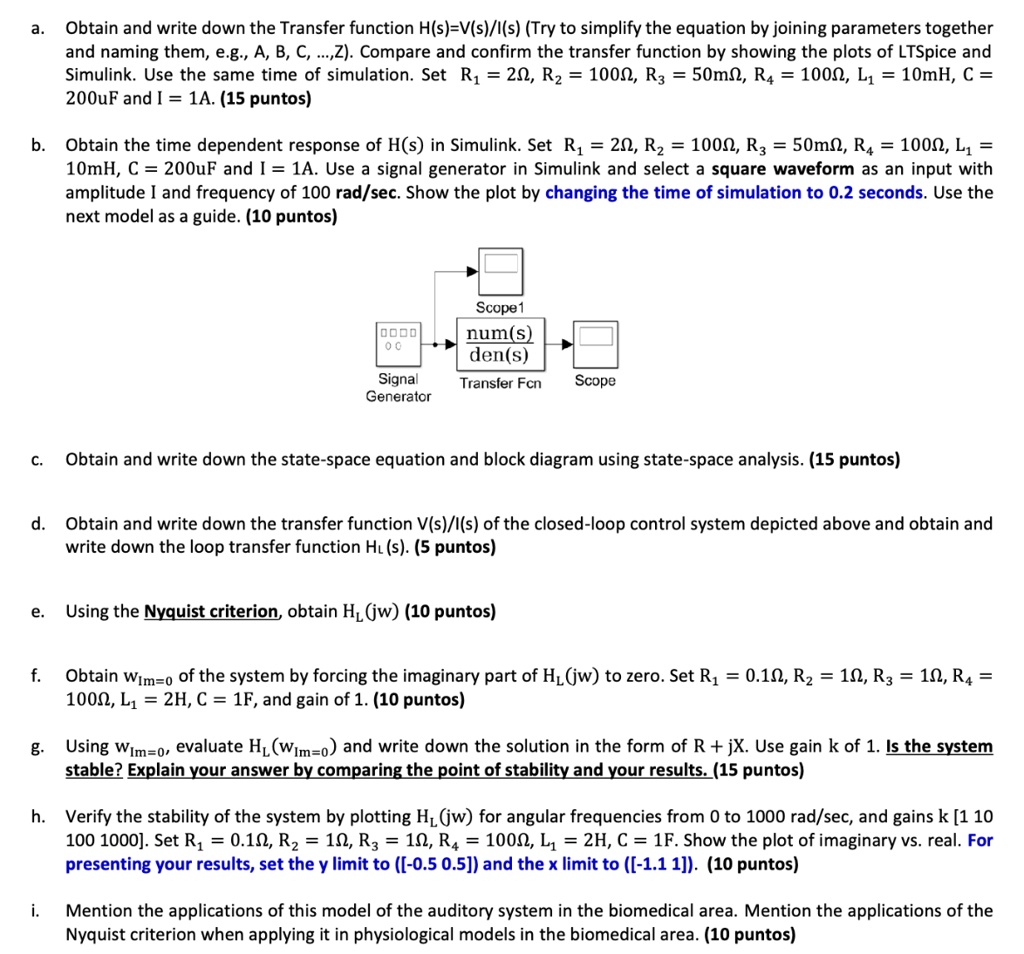
Obtain the time-dependent response of H(s) in Simulink. Set R = 2, R = 100, R = 50m, R = 100, L = 10mH, C = 200uF, and I = 1A. Use a signal generator in Simulink and select a square waveform as an input with amplitude I and frequency of 100 rad/sec. Show the plot by changing the time of simulation to 0.2 seconds. Use the next model as a guide. (10 puntos)
Scope1
0000 00
num(s) den(s) Transfer Fcn
Signal Generator
Scope
c.
Obtain and write down the state-space equation and block diagram using state-space analysis. (15 puntos)
d.
Obtain and write down the transfer function V(s)/I(s) of the closed-loop control system depicted above and obtain and write down the loop transfer function H(s). (5 puntos)
e.
Using the Nyquist criterion, obtain H(jw). (10 puntos)
f.
Obtain wim=o of the system by forcing the imaginary part of H(jw) to zero. Set R = 0.1, R = 1, R = 1, R4 = 100, L = 2H, C = 1F, and gain of 1. (10 puntos)
g.
Is the system stable? Explain your answer by comparing the point of stability and your results. (15 puntos)
h.
Verify the stability of the system by plotting H(jw) for angular frequencies from 0 to 1000 rad/sec, and gains k [1 10 100 1000]. Set R = 0.1, R = 1, R = 1, R = 100, L = 2H, C = 1F. Show the plot of imaginary vs. real. For presenting your results, set the y limit to ([-0.5 0.5]) and the x limit to ([-1.1 1]). (10 puntos)
i.
Mention the applications of this model of the auditory system in the biomedical area. Mention the applications of the Nyquist criterion when applying it in physiological models in the biomedical area. (10 puntos)