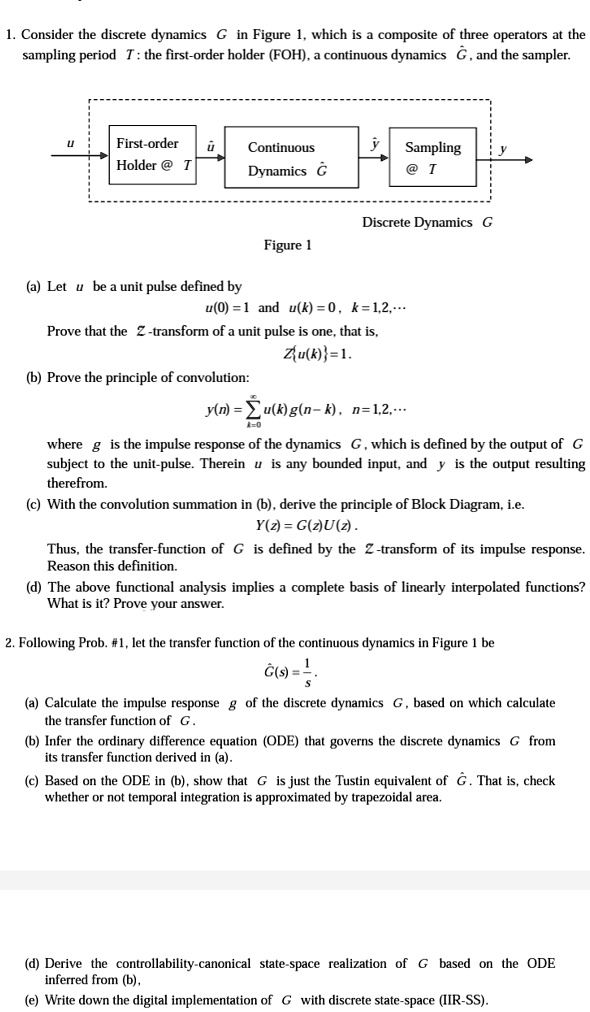
1. Consider the discrete dynamics G in Figure 1, which is a composite of three operators at the
sampling period T: the first-order holder (FOH), a continuous dynamics \(\tilde{G}\), and the sampler.
First-order
Holder @ T
u
Continuous
Dynamics \(\tilde{G}\)
Sampling
@ T
y
Discrete Dynamics G
Figure 1
(a) Let u be a unit pulse defined by
u(0) = 1 and u(k) = 0, k = 1, 2, ...
Prove that the Z-transform of a unit pulse is one, that is,
\(\mathcal{Z}\{u(k)\} = 1.
(b) Prove the principle of convolution:
\(y(n) = \sum_{k=0}^{\infty} u(k)g(n - k)\), \(n = 1, 2, ...\)
where g is the impulse response of the dynamics G, which is defined by the output of G
subject to the unit-pulse. Therein u is any bounded input, and y is the output resulting
therefrom.
(c) With the convolution summation in (b), derive the principle of Block Diagram, i.e.
\(Y(z) = G(z)U(z)\).
Thus, the transfer-function of G is defined by the Z-transform of its impulse response.
Reason this definition.
(d) The above functional analysis implies a complete basis of linearly interpolated functions?
What is it? Prove your answer.
2. Following Prob. #1, let the transfer function of the continuous dynamics in Figure 1 be
\(\tilde{G}(s) = \frac{1}{s}\).
(a) Calculate the impulse response g of the discrete dynamics G, based on which calculate
the transfer function of G.
(b) Infer the ordinary difference equation (ODE) that governs the discrete dynamics G from
its transfer function derived in (a).
(c) Based on the ODE in (b), show that G is just the Tustin equivalent of \(\tilde{G}\). That is, check
whether or not temporal integration is approximated by trapezoidal area.
(d) Derive the controllability-canonical state-space realization of G based on the ODE
inferred from (b),
(e) Write down the digital implementation of G with discrete state-space (IIR-SS).