Ace - AI Tutor
Ask Our Educators
Textbooks
My Library
Flashcards
Scribe - AI Notes
Notes & Exams
Download App
james lopez

james l.

Divider

Questions asked

BEST MATCH

Internal transactions are events that affect the financial position of the company but do not include an exchange with a separate economic entity. True or False

View Answer
divider
BEST MATCH

Perform the indicated operations given the matrices. 19) Let A = [[1,3][2,5]] and B = [[0,4][-1,6]]; 3A + B

View Answer
divider
BEST MATCH

Show me the steps to solveEffective family assessment begins with health care providers engaging in which of the following?

View Answer
divider
BEST MATCH

When does the inguinal ring typically seal off in men? Shortly before birth Shortly after birth During puberty Never

View Answer
divider
BEST MATCH

Question 1 0.5 pts if attempts to place politically backed candidates are successful, the response is that the competencies necessary for informed public policy formulation and implementation are unchanged redefined eroded enhanced

View Answer
divider
BEST MATCH

points) What forms of deception occurred? Highlight the form of deception, the deceiving actor(s), and why an act is a particular form of deception.

View Answer
divider
BEST MATCH

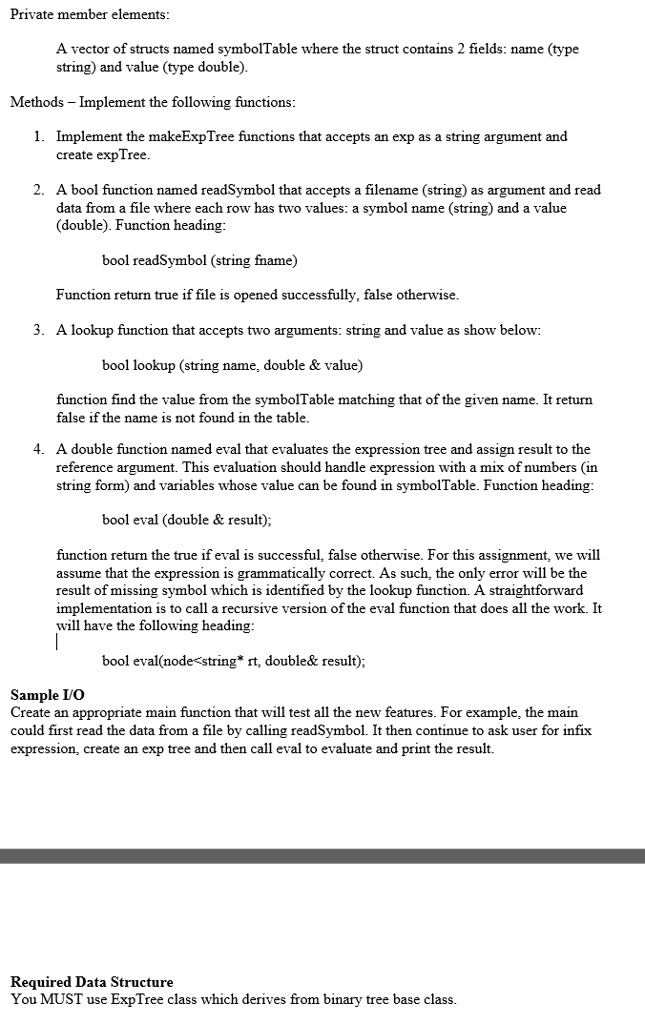
Private member elements: A vector of structs named symbolTable where the struct contains 2 fields: name (type string) and value (type double). Methods - Implement the following functions: 1. Implement the makeExpTree functions that accepts an exp as a string argument and create expTree. 2. A bool function named readSymbol that accepts a filename (string) as argument and read data from a file where each row has two values: a symbol name (string) and a value (double). Function heading: bool readSymbol (string fname) Function return true if file is opened successfully, false otherwise. 3. A lookup function that accepts two arguments: string and value as show below: bool lookup (string name, double & value) function find the value from the symbolTable matching that of the given name. It return false if the name is not found in the table. 4. A double function named eval that evaluates the expression tree and assign result to the reference argument. This evaluation should handle expression with a mix of numbers (in string form) and variables whose value can be found in symbolTable. Function heading: bool eval (double & result); function return the true if eval is successful, false otherwise. For this assignment, we will assume that the expression is grammatically correct. As such, the only error will be the result of missing symbol which is identified by the lookup function. A straightforward implementation is to call a recursive version of the eval function that does all the work. It will have the following heading: bool eval(node<string* rt, double& result); Sample I/O Create an appropriate main function that will test all the new features. For example, the main could first read the data from a file by calling readSymbol. It then continue to ask user for infix expression, create an exp tree and then call eval to evaluate and print the result. Required Data Structure You MUST use ExpTree class which derives from binary tree base class.
View Answer
divider
BEST MATCH

The area of the surface obtained by rotating the curve $y = \sqrt{49 - x^2}$, $-1 \le x \le 1$ about the x-axis is

View Answer
divider
BEST MATCH

Calculate the Return on equity from the following data. OMR Net Profit after Tax 6,00,000 10% Debentures (OMR 10 each) 10,00,000 Equity Share Capital (OMR 10 per share) 10,00,000

View Answer
divider
BEST MATCH

(a) When programming with Java, most classes need to be imported before they can be used in an application. Why are applications able to use the class System without first importing it? (2 marks) (b) What is the importance of exception handling in Java programming? (2 marks) (c) Explain why we got compilation errors in the following Java codes. (3 marks) public class Test { public static void main(String[] args) { try { int a[]= {1, 2, 3, 4}; for (int i = 0; i <= 3; i++) { System.out.println ("a[" + i + "]=" + a[i] + "\n"); } } catch (Exception e) { System.out.println ("Error is " + e); } } catch (IllegalArgumentException e) { System.out.println("IllegalArgumentException"); } catch (ArrayIndexOutOfBoundsException e) { System.out.println("ArrayIndexOutOfBoundsException"); } } (d) Explain the usage of "throw ex" in the following code segment. (3 marks) try { String s = null; System.out.println(s.length()); NullPointerException } catch (NullPointerException ex) { System.out.println("NullPointerException is caught here"); throw ex; // Explain the usage of this }

View Answer
divider