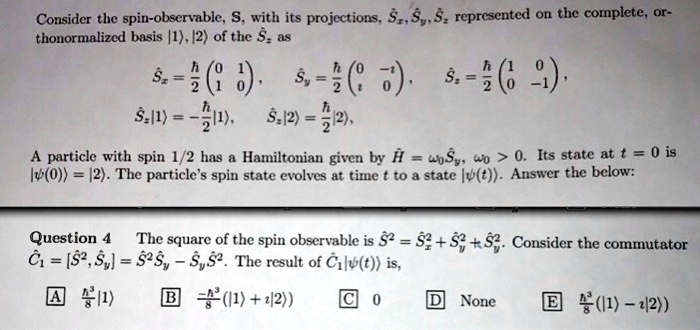
Consider the spin-observable, S, with its projections, $\tilde{S}_x$, $\tilde{S}_y$, $\tilde{S}_z$ represented on the complete, orthonormalized basis $|1\rangle$, $|2\rangle$ of the $\tilde{S}_z$ as
$\tilde{S}_x = \frac{\hbar}{2} \begin{pmatrix} 0 & 1\\ 1 & 0 \end{pmatrix}$, $\tilde{S}_y = \frac{\hbar}{2} \begin{pmatrix} 0 & -i\\ i & 0 \end{pmatrix}$, $\tilde{S}_z = \frac{\hbar}{2} \begin{pmatrix} 1 & 0\\ 0 & -1 \end{pmatrix}$,
$\tilde{S}_z|1\rangle = \frac{\hbar}{2}|1\rangle$, $\tilde{S}_z|2\rangle = \frac{-\hbar}{2}|2\rangle$,
A particle with spin 1/2 has a Hamiltonian given by $H = \omega_0 \tilde{S}_y$, $\omega_0 > 0$. Its state at $t = 0$ is
$|\psi(0)\rangle = |2\rangle$. The particle's spin state evolves at time $t$ to a state $|\psi(t)\rangle$. Answer the below:
Question 4 The square of the spin observable is $\tilde{S}^2 = \tilde{S}_x^2 + \tilde{S}_y^2 + \tilde{S}_z^2$. Consider the commutator
$\tilde{C}_1 = [\tilde{S}^2, \tilde{S}_y] = \tilde{S}^2 \tilde{S}_y - \tilde{S}_y \tilde{S}^2$. The result of $\tilde{C}_1|\psi(t)\rangle$ is,
A $\frac{\hbar^3}{8}|1\rangle$ B $\frac{-\hbar^3}{8}(|1\rangle + i|2\rangle)$ C 0 D None E $\frac{\hbar^3}{8}(|1\rangle - i|2\rangle)$