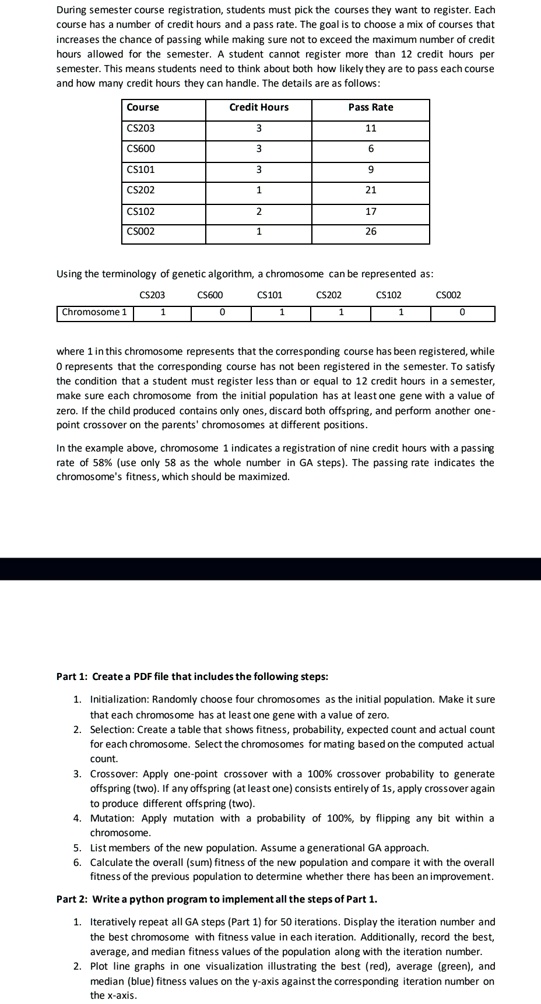
During semester course registration, students must pick the courses they want to register. Each course has a number of credit hours and a pass rate. The goal is to choose a mix of courses that increases the chance of passing while making sure not to exceed the maximum number of credit hours allowed for the semester. A student cannot register more than 12 credit hours per semester. This means students need to think about both how likely they are to pass each course and how many credit hours they can handle. The details are as follows:
able[[Course,Credit Hours,Pass Rate],[CS203,3,11],[CS600,3,6],[CS101,3,9],[CS202,1,21],[CS102,2,17],[CS002,1,26]]
Using the terminology of genetic algorithm, a chromosome can be represented as:
able[[CS203,CS600,CS101,CS202,CS002,,],[Chromosome 1,1,0,1,1,1,0]]
where 1 in this chromosome represents that the corresponding course has been registered, while 0 represents that the corresponding course has not been registered in the semester. To satisfy the condition that a student must register less than or equal to 12 credit hours in a semester, make sure each chromosome from the initial population has at least one gene with a value of zero. If the child produced contains only ones, discard both offspring, and perform another onepoint crossover on the parents' chromosomes at different positions.
In the example above, chromosome 1 indicates a registration of nine credit hours with a passing rate of 58% (use only 58 as the whole number in GA steps). The passing rate indicates the chromosome's fitness, which should be maximized.
Part 1: Create a PDF file that includes the following steps:
Initialization: Randomly choose four chromosomes as the initial population. Make it sure that each chromosome has at least one gene with a value of zero.
Selection: Create a table that shows fitness, probability, expected count and actual count for each chromosome. Select the chromosomes for mating based on the computed actual count.
Crossover: Apply one-point crossover with a 100% crossover probability to generate offspring (two). If any offspring (at least one) consists entirely of 1s, apply crossover again to produce different offspring (two).
Mutation: Apply mutation with a probability of 100%, by flipping any bit within a chromosome.
List members of the new population. Assume a generational GA approach.
Calculate the overall (sum) fitness of the new population and compare it with the overall fitness of the previous population to determine whether there has been an improvement.
Part 2: Write a python program to implement all the steps of Part 1.
Iteratively repeat all GA steps (Part 1) for 50 iterations. Display the iteration number and the best chromosome with fitness value in each iteration. Additionally, record the best, average, and median fitness values of the population along with the iteration number.
Plot line graphs in one visualization illustrating the best (red), average (green), and median (blue) fitness values on the y-axis against the corresponding iteration number on the x-axis.
During semester course registration, students must pick the courses they want to register. Each course has a number of credit hours and a pass rate. The goal is to choose a mix of courses that increases the chance of passing while making sure not to exceed the maximum number of credit hours allowed for the semester. A student cannot register more than 12 credit hours per semester. This means students need to think about both how likely they are to pass each course and how many credit hours they can handle. The details are as follows:
Course CS203 CS600 CS101 CS202 CS102 CS002
Credit Hours
Pass Rate 11
3 3 3 1 2 1
6
6
21
17 26
Using the terminology of genetic algorithm, a chromosome can be represented as:
CS203 Chromosome1 1
CS600 0
CS101
CS202 1
CS102
CS002 0
where 1 in this chromosome represents that the corresponding course has been registered, while
the condition that a student must register less than or equal to 12 credit hours in a semester, make sure each chromosome from the initial population has at least one gene with a value of zero. If the child produced contains only ones, discard both offspring, and perform another one-
In the example above, chromosome 1 indicates a registration of nine credit hours with a passing rate of 58% (use only 58 as the whole number in GA steps). The passing rate indicates the chromosome's fitness, which should be maximized.
Part 1: Create a PDF file that includes the following steps:
1. Initialization: Randomly choose four chromosomes as the initial population. Make it sure that each chromosome has at least one gene with a value of zero. Selection: Create a table that shows fitness, probability, expected count and actual count for each chromosome. Select the chromosomes for mating based on the computed actual count. 3. Crossover: Apply one-point crossover with a 100% crossover probability to generate offspring (two). If any offspring (at least one) consists entirely of 1s, apply crossover again to produce different offspring (two). 4. chromosome. 5. List members of the new population. Assume a generational GA approach. Calculate the overall (sum) fitness of the new population and compare it with the overall fitness of the previous population to determine whether there has been an improvement.
Part 2: Write a python program to implement all the steps of Part 1.
1. Iteratively repeat all GA steps (Part 1) for 50 iterations. Display the iteration number and the best chromosome with fitness value in each iteration. Additionally, record the best, average, and median fitness values of the population along with the iteration number. 2. Plot line graphs in one visualization illustrating the best (red), average (green), and median (blue) fitness values on the y-axis against the corresponding iteration number on the x-axis.