$\vec{B} = \frac{\mu_0 I}{4\pi} \int \frac{d\vec{s} \times \hat{r}}{r^2}$
Problem 2: Let's examine what the vectors involved in the Biot-Savart Law represent, think about how we might write them down using proper vector notation, and apply what we know about cross products.
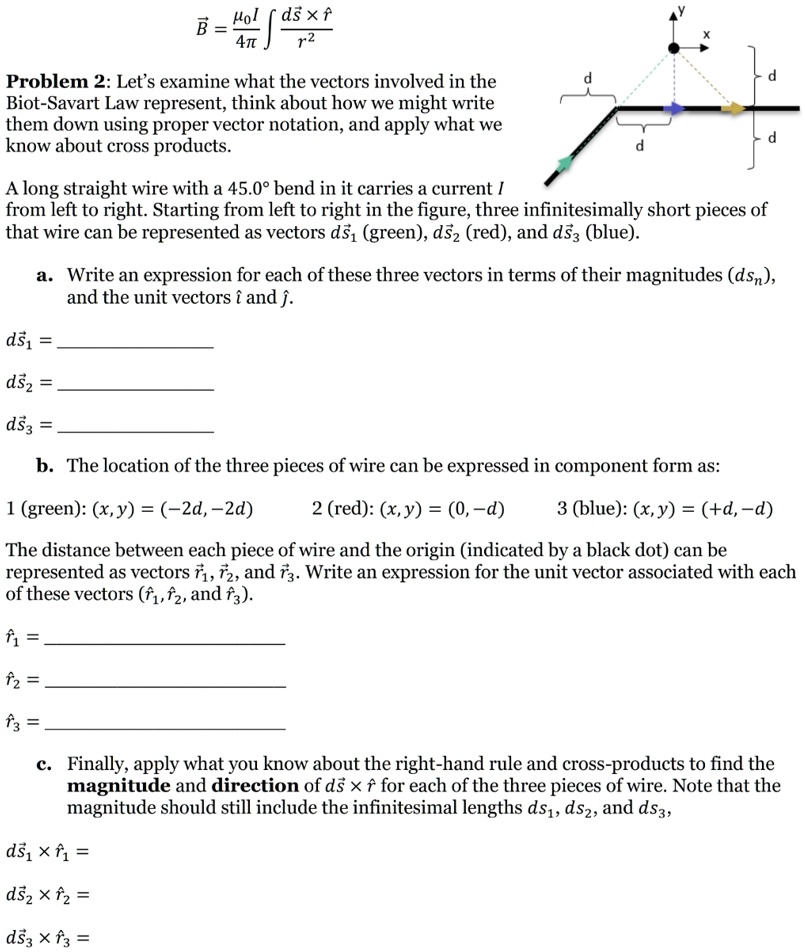
A long straight wire with a 45.0° bend in it carries a current $I$ from left to right. Starting from left to right in the figure, three infinitesimally short pieces of that wire can be represented as vectors $d\vec{s_1}$ (green), $d\vec{s_2}$ (red), and $d\vec{s_3}$ (blue).
a. Write an expression for each of these three vectors in terms of their magnitudes ($ds_n$), and the unit vectors $\hat{i}$ and $\hat{j}$.
$d\vec{s_1} = $
$d\vec{s_2} = $
$d\vec{s_3} = $
b. The location of the three pieces of wire can be expressed in component form as:
1 (green): $(x, y) = (-2d, -2d)$
2 (red): $(x, y) = (0, -d)$
3 (blue): $(x, y) = (+d, -d)$
The distance between each piece of wire and the origin (indicated by a black dot) can be represented as vectors $\vec{r_1}$, $\vec{r_2}$, and $\vec{r_3}$. Write an expression for the unit vector associated with each of these vectors ($\hat{r_1}$, $\hat{r_2}$, and $\hat{r_3}$).
$\vec{r_1} = $
$\vec{r_2} = $
$\vec{r_3} = $
c. Finally, apply what you know about the right-hand rule and cross-products to find the magnitude and direction of $d\vec{s} \times \hat{r}$ for each of the three pieces of wire. Note that the magnitude should still include the infinitesimal lengths $ds_1$, $ds_2$, and $ds_3$.
$d\vec{s_1} \times \hat{r_1} = $
$d\vec{s_2} \times \hat{r_2} = $
$d\vec{s_3} \times \hat{r_3} = $