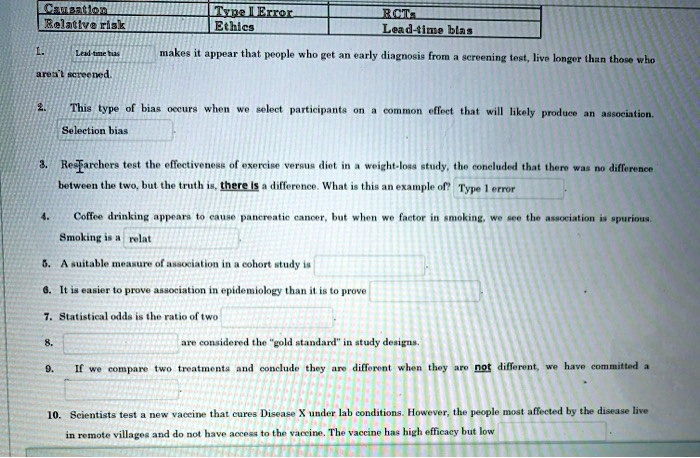
Causation, Relative risk
Type I Error, Ethics
RCT, Lead-time bias
Lead-time, t-test
It makes it appear that people who get an early diagnosis from a screening test live longer than those who are not screened.
This type of bias occurs when we select participants based on a common effect that will likely produce an association - Selection bias.
Researchers test the effectiveness of exercise versus diet in a weight-loss study. They concluded that there was no difference between the two, but the truth is, there is a difference. This is an example of Type 1 error.
Coffee drinking appears to cause pancreatic cancer, but when we factor in smoking, we see that the association is spurious - Smoking is a confounding factor.
5. A suitable measure of association in a cohort study is Relative risk.
It is easier to prove association in epidemiology than it is to prove causation.
7. Statistical odds is the ratio of two probabilities.
RCTs (Randomized Controlled Trials) are considered the gold standard in study designs.
9. If we compare two treatments and conclude they are different when they are not different, we have made a Type 1 error.
10. Scientists test a new vaccine that cures Disease X under lab conditions. However, the people most affected by the disease live in remote villages and do not have access to the vaccine. The vaccine has high efficacy but low accessibility.