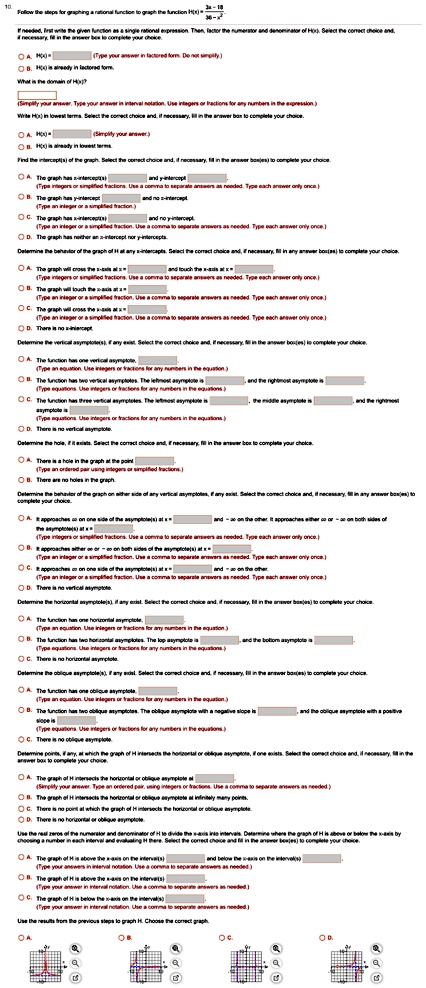
Follow the steps for graphing a rational function to graph the function $H(x) = \frac{3x-18}{30-x^2}$.
If needed, first write the given function as a single rational expression. Then, factor the numerator and denominator of $H(x)$. Select the correct choice and, if necessary, fill in the answer box to complete your choice.
A. $H(x) = $ (Type your answer in factored form. Do not simplify.)
B. $H(x)$ is already in factored form.
What is the domain of $H(x)$?
(Simplify your answer. Type your answer in interval notation. Use integers or fractions for any numbers in the expression.)
Write $H(x)$ in lowest terms. Select the correct choice and, if necessary, fill in the answer box to complete your choice.
A. $H(x) = $ (Simplify your answer.)
B. $H(x)$ is already in lowest terms.
Find the intercept(s) of the graph. Select the correct choice and, if necessary, fill in the answer box(es) to complete your choice.
A. The graph has $x$-intercept(s) ______ and $y$-intercept ______.
(Type integers or simplified fractions. Use a comma to separate answers as needed. Type each answer only once.)
B. The graph has an $x$-intercept ______ and no $y$-intercept.
(Type an integer or a simplified fraction.)
C. The graph has a $y$-intercept ______ and no $x$-intercepts.
(Type an integer or a simplified fraction. Use a comma to separate answers as needed. Type each answer only once.)
D. The graph has neither an $x$-intercept nor $y$-intercepts.
Determine the behavior of the graph of $H$ at any $x$-intercepts. Select the correct choice and, if necessary, fill in any answer box(es) to complete your choice.
A. The graph will cross the $x$-axis at $x = $ ______ and touch the $x$-axis at $x = $ ______.
(Type integers or simplified fractions. Use a comma to separate answers as needed. Type each answer only once.)
B. The graph will touch the $x$-axis at $x = $ ______.
(Type an integer or a simplified fraction. Use a comma to separate answers as needed. Type each answer only once.)
C. The graph will cross the $x$-axis at $x = $ ______.
(Type an integer or a simplified fraction. Use a comma to separate answers as needed. Type each answer only once.)
D. There is no $x$-intercept.
Determine the vertical asymptote(s), if any exist. Select the correct choice and, if necessary, fill in the answer box(es) to complete your choice.
A. The function has one vertical asymptote. The asymptote is $x = $ ______.
(Type an equation. Use integers or fractions for any numbers in the equation.)
B. The function has two vertical asymptotes. The leftmost asymptote is $x = $ ______, and the rightmost asymptote is $x = $ ______.
(Type equations. Use integers or fractions for any numbers in the equations.)
C. The function has three vertical asymptotes. The leftmost asymptote is $x = $ ______, the middle asymptote is $x = $ ______, and the rightmost asymptote is $x = $ ______.
(Type equations. Use integers or fractions for any numbers in the equations.)
D. There is no vertical asymptote.
Determine the hole, if it exists. Select the correct choice and, if necessary, fill in the answer box to complete your choice.
A. There is a hole in the graph at the point ______.
(Type an ordered pair using integers or simplified fractions.)
B. There are no holes in the graph.
Determine the behavior of the graph on either side of any vertical asymptote(s), if any exist. Select the correct choice and, if necessary, fill in any answer box(es) to complete your choice.
A. It approaches $\infty$ on one side of the asymptote(s) at $x = $ ______ and $-\infty$ on the other. It approaches either $\infty$ or $-\infty$ on both sides of the asymptote(s) at $x = $ ______.
(Type integers or simplified fractions. Use a comma to separate answers as needed. Type each answer only once.)
B. It approaches either $\infty$ or $-\infty$ on both sides of the asymptote(s) at $x = $ ______.
(Type an integer or a simplified fraction. Use a comma to separate answers as needed. Type each answer only once.)
C. It approaches $\infty$ on one side of the asymptote(s) at $x = $ ______ and $-\infty$ on the other.
(Type an integer or a simplified fraction. Use a comma to separate answers as needed. Type each answer only once.)
D. There is no vertical asymptote.
Determine the horizontal asymptote(s), if any exist. Select the correct choice and, if necessary, fill in the answer box(es) to complete your choice.
A. The function has one horizontal asymptote. The asymptote is $y = $ ______.
(Type an equation. Use integers or fractions for any numbers in the equation.)
B. The function has two horizontal asymptotes. The top asymptote is $y = $ ______, and the bottom asymptote is $y = $ ______.
(Type equations. Use integers or fractions for any numbers in the equations.)
C. There is no horizontal asymptote.
Determine the oblique asymptote(s), if any exist. Select the correct choice and, if necessary, fill in the answer box(es) to complete your choice.
A. The function has one oblique asymptote. The asymptote is $y = $ ______.
(Type an equation. Use integers or fractions for any numbers in the equation.)
B. The function has two oblique asymptotes. The oblique asymptote with a negative slope is $y = $ ______, and the oblique asymptote with a positive slope is $y = $ ______.
(Type equations. Use integers or fractions for any numbers in the equations.)
C. There is no oblique asymptote.
Determine points, if any, at which the graph of $H$ intersects the horizontal or oblique asymptote. If one exists, select the correct choice and, if necessary, fill in the answer box to complete your choice.
A. The graph of $H$ intersects the horizontal or oblique asymptote at ______.
(Simplify your answer. Type an ordered pair, using integers or fractions. Use a comma to separate answers as needed.)
B. The graph of $H$ intersects the horizontal or oblique asymptote at infinitely many points.
C. There is no point at which the graph of $H$ intersects the horizontal or oblique asymptote.
D. There is no horizontal or oblique asymptote.
Use the real zeros of the numerator and denominator of $H$ to divide the $x$-axis into intervals. Determine where the graph of $H$ is above or below the $x$-axis by choosing a number in each interval and evaluating $H$ there. Select the correct choice and fill in the answer box(es) to complete your choice.
A. The graph of $H$ is above the $x$-axis on the interval(s) ______ and below the $x$-axis on the interval(s) ______.
(Type your answers in interval notation. Use a comma to separate answers as needed.)
B. The graph of $H$ is above the $x$-axis on the interval(s) ______.
(Type your answer in interval notation. Use a comma to separate answers as needed.)
C. The graph of $H$ is below the $x$-axis on the interval(s) ______.
(Type your answer in interval notation. Use a comma to separate answers as needed.)
Use the results from the previous steps to graph $H$. Choose the correct graph.