Solution
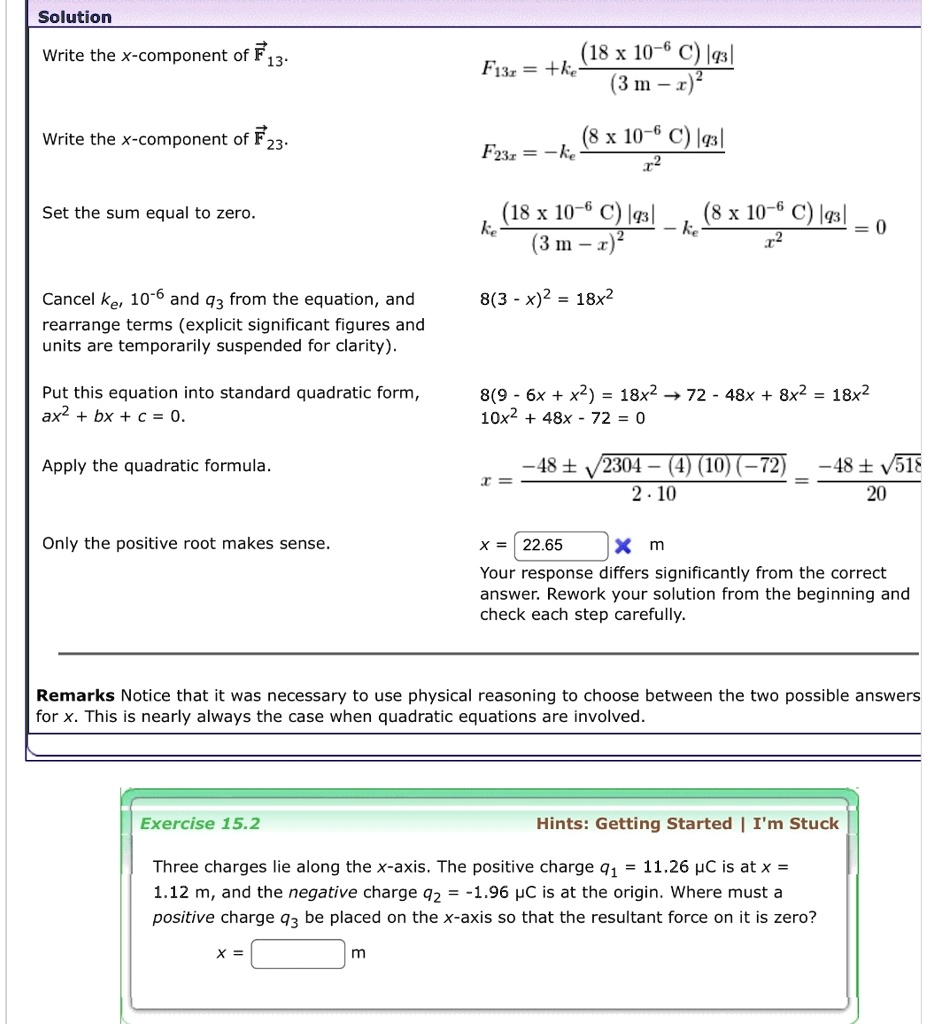
Write the x-component of vec(F)_(13).
F_(13x)=+k_(e)((18 imes 10^(-6)C)|q_(3)|)/((3(m)-x)^(2))
Write the x-component of vec(F)_(23).
F_(23x)=-k_(e)((8 imes 10^(-6)C)|q_(3)|)/(x^(2))
Set the sum equal to zero.
k_(e)((18 imes 10^(-6)C)|q_(3)|)/((3(m)-x)^(2))-k_(e)((8 imes 10^(-6)C)|q_(3)|)/(x^(2))=0
8(3-x)^(2)=18x^(2)
Cancel k_(e),10^(-6) and q_(3) from the equation, and rearrange terms (explicit significant figures and units are temporarily suspended for clarity).
Put this equation into standard quadratic form, ax^(2)+bx+c=0.
8(9-6x+x^(2))=18x^(2)->72-48x+8x^(2)=18x^(2)
10x^(2)+48x-72=0
Apply the quadratic formula.
x=(-48+-sqrt(2304-(4)(10)(-72)))/(2*10)=(-48+-sqrt(518))/(20)
Only the positive root makes sense.
x=
m
Your response differs significantly from the correct answer. Rework your solution from the beginning and check each step carefully.
Remarks Notice that it was necessary to use physical reasoning to choose between the two possible answers for x. This is nearly always the case when quadratic equations are involved.
Exercise 15.2
Hints: Getting Started | I'm Stuck
Three charges lie along the x-axis. The positive charge q_(1)=11.26mu C is at x= 1.12m, and the negative charge q_(2)=-1.96mu C is at the origin. Where must a positive charge q_(3) be placed on the x-axis so that the resultant force on it is zero?
x=,m
Solution
(18 x 10-6 C) (q3| F13x=+ke 3m - x)2
(8 x 10⁻⁶ C) |q3) F23x=-k x2
Set the sum equal to zero
(18 x 10-6 C) |q3| (3 m - x)2
Cancel ke, 10-6 and q3 from the equation, and rearrange terms(explicit significant figures and units are temporarily suspended for clarity)
8(3 - x)2= 18x2
Put this equation into standard quadratic form, ax2 + bx +c = 0.
89-6x+x2=182-72-48x+82=18x2 10x2+48x-72=0
Apply the quadratic formula.
48 /2304 (4) (10) (72) 48 v518 2.10 20
Only the positive root makes sense.
22.65
X m
Your response differs significantly from the correct answer. Rework your solution from the beginning and check each step carefully.
Remarks Notice that it was necessary to use physical reasoning to choose between the two possible answers for x.This is nearly always the case when quadratic equations are involved.
Exercise 15.2
Hints:Getting Started l I'm Stuck
Three charges lie along the x-axis. The positive charge q1 = 11.26 C is at x = 1.12 m, and the negative charge q2 = -1.96 C is at the origin. Where must a positive charge q3 be placed on the x-axis so that the resultant force on it is zero?