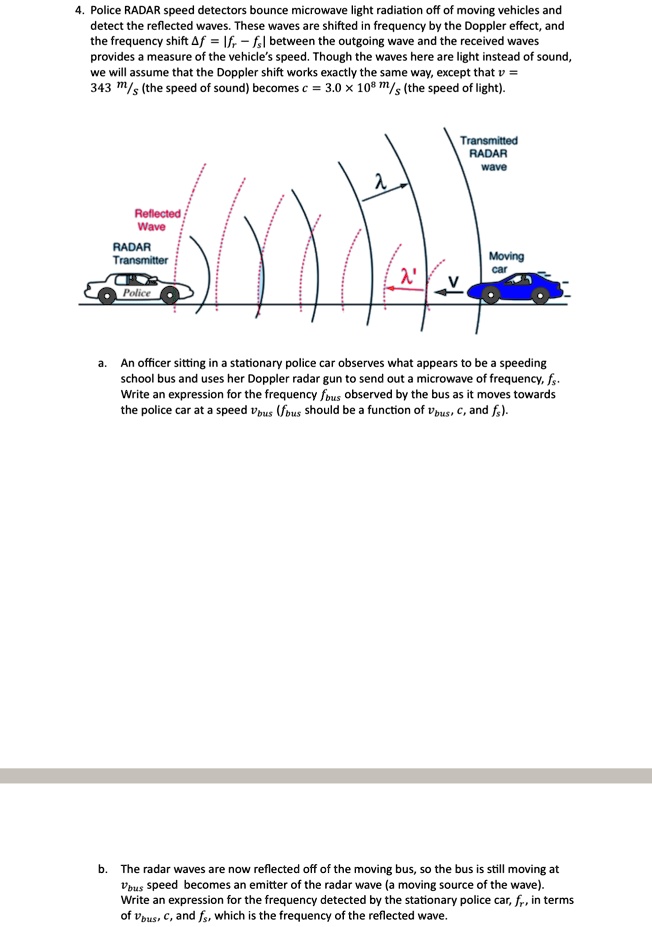
4. Police RADAR speed detectors bounce microwave light radiation off of moving vehicles and detect the reflected waves. These waves are shifted in frequency by the Doppler effect, and the frequency shift \(\Delta f = f_r - f_s\) between the outgoing wave and the received waves provides a measure of the vehicle's speed. Though the waves here are light instead of sound, we will assume that the Doppler shift works exactly the same way, except that \(v = 343 \text{ m/s}\) (the speed of sound) becomes \(c = 3.0 \times 10^8 \text{ m/s}\) (the speed of light).
a. An officer sitting in a stationary police car observes what appears to be a speeding school bus and uses her Doppler radar gun to send out a microwave of frequency, \(f_s\). Write an expression for the frequency \(f_{bus}\) observed by the bus as it moves towards the police car at a speed \(v_{bus}\) (\(f_{bus}\) should be a function of \(v_{bus}\), c, and \(f_s\)).
b. The radar waves are now reflected off of the moving bus, so the bus is still moving at \(v_{bus}\) speed becomes an emitter of the radar wave (a moving source of the wave). Write an expression for the frequency detected by the stationary police car, \(f_r\), in terms of \(v_{bus}\), c, and \(f_s\), which is the frequency of the reflected wave.