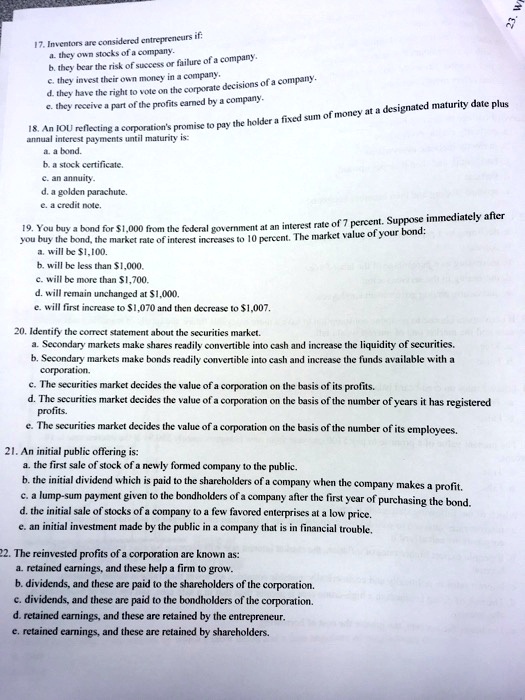
a. They own stocks of a company.
c. They invest their own money in a company.
e. They receive a part of the profits earned by a company.
Annual interest payments until maturity are: a. a bond. b. a stock certificate c. an annuity. d. a golden parachute. e. a credit note.
a. Will be $1,100.
b. Will be less than $1,000.
c. Will be more than $1,700.
d. Will remain unchanged at $1,000.
e. Will first increase to $1,070 and then decrease to $1,007.
20. Identify the correct statement about the securities market:
a. Secondary markets make shares readily convertible into cash and increase the liquidity of securities.
b. Secondary markets make bonds readily convertible into cash and increase the funds available with a corporation.
c. The securities market decides the value of a corporation on the basis of its profits.
d. The securities market decides the value of a corporation on the basis of the number of years it has registered profits.
e. The securities market decides the value of a corporation on the basis of the number of its employees.
21. An initial public offering is:
a. The first sale of stock of a newly formed company to the public.
b. The initial dividend which is paid to the shareholders of a company when the company makes a profit.
c. The initial sale of stocks of a company to a few favored enterprises at a low price.
d. An initial investment made by the public in a company that is in financial trouble.
2. The reinvested profits of a corporation are known as:
a. Retained earnings, and these help a firm to grow.
b. Dividends, and these are paid to the shareholders of the corporation.
c. Dividends, and these are paid to the bondholders of the corporation.
d. Retained earnings, and these are retained by the entrepreneur.
e. Retained earnings, and these are retained by shareholders.