Ace - AI Tutor
Ask Our Educators
Textbooks
My Library
Flashcards
Scribe - AI Notes
Notes & Exams
Download App
jamie gray

jamie g.

Divider

Questions asked

BEST MATCH

According to John Bowlby's attachment theory, how does the quality of the mother-child relationship in the first year of life influence later social relationships? It has little impact, as social relationships are primarily shaped by later life experiences. It determines the formation of social relationships later in life by fulfilling an innate need for attachment. It is based solely on reinforcement when basic physiological needs are satisfied, as behaviorism suggests. It plays a minor role compared to genetic predispositions in shaping future relationships.

View Answer
divider
BEST MATCH

12. Trace the flow of a drop of blood from the small intestine to the right atrium of the heart, noting all structures encountered or passed through on the way. 13. Trace the pathway of a $CO_2$ gas molecule in the blood from the inferior vena cava until it reaches the bloodstream at the alveolar sacs of the lung. Name all structures (vessels, heart chambers, and others) passed through en route. 3.

View Answer
divider
BEST MATCH

Complete the passage describing how a positive feedback mechanism regulates childbirth. The initial contractions of labor, the push the baby's head or body into the lowest part of the uterus where detect increased stretching in the cervix. The afferent pathway transmits this sensory input to the hypothalamus of the brain, the Next, the hypothalamus signals the posterior pituitary to release the hormone oxytocin into the bloodstream. Oxytocin represents output information that stimulates the the smooth muscle of the uterus, to contract. Further contraction causes additional stretching of the cervix. The response the initial stimulus and feeds back to the input portion of the pathway, The positive feedback mechanism ends when delivery of the baby releases the stretch on the cervix.

View Answer
divider
BEST MATCH

15. Find the sum of the series: (a) $\sum_{n=0}^{\infty} (-1)^n \cdot \frac{x^{4n}}{n!}$ (b) $\sum_{n=0}^{\infty} (-1)^{n-1} \cdot \frac{3^n}{n5^n}$ (c) $\sum_{n=0}^{\infty} \frac{(-1)^n \pi^{2n+1}}{4^{2n+1}(2n+1)!}$ (d) $3 + \frac{9}{2!} + \frac{27}{3!} + \frac{81}{4!} + ...$

View Answer
divider
BEST MATCH

4. What pathophysiological process best explains progressive neurological deterioration in a patient with acute liver failure? Cerebral hypoperfusion Seizures Cerebral edema Intracranial hypotension Cerebral venous thrombosis

View Answer
divider
BEST MATCH

Problem 1: R3 V? = 10V R? = 5? + R? V? R? = 10? R? R? R? = 6? R? = 4? Find all currents & voltages in the circuit. let R? = R? + R? = 10?

View Answer
divider
BEST MATCH

If the actual inflation rate is less than the expected inflation rate, which of the following must be true?

View Answer
divider
BEST MATCH

Express the hexadecimal number \text{DE43}_{16} as a binary (base 2) number.

View Answer
divider
BEST MATCH

Find the domain of the function \(f(x) = \frac{\sqrt{x-1}}{x^2 - x - 6}\)

View Answer
divider
BEST MATCH

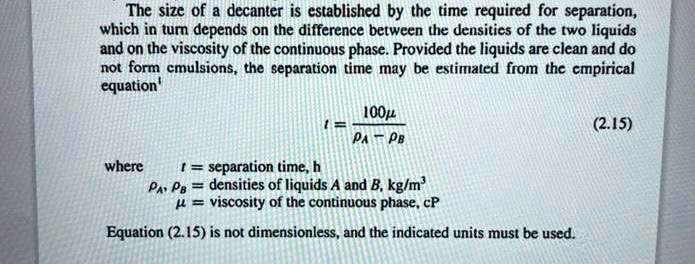
The size of a decanter is established by the time required for separation, which in turn depends on the difference between the densities of the two liquids and on the viscosity of the continuous phase. Provided the liquids are clean and do not form emulsions, the separation time may be estimated from the empirical equation \begin{equation} t = \frac{100\mu}{\rho_A - \rho_B} \end{equation} (2.15) where $t$ = separation time, h $\rho_A$, $\rho_B$ = densities of liquids A and B, kg/m³ $\mu$ = viscosity of the continuous phase, cP Equation (2.15) is not dimensionless, and the indicated units must be used.
View Answer
divider