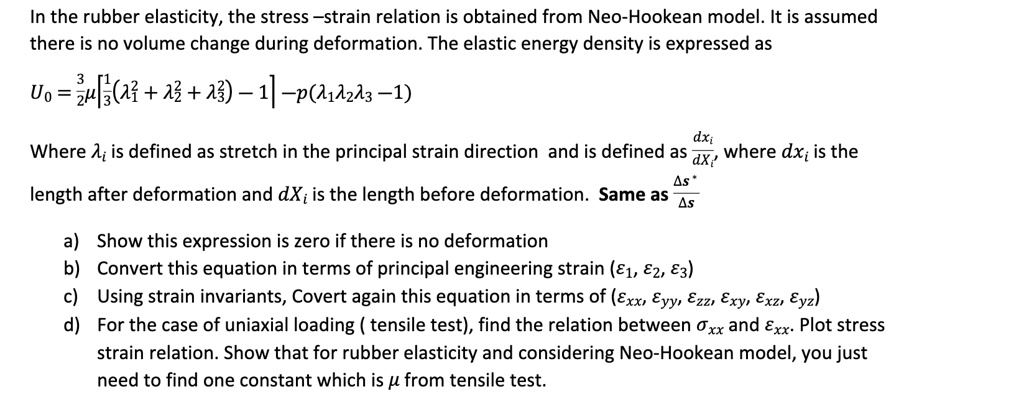
In the rubber elasticity, the stress -strain relation is obtained from Neo-Hookean model. It is assumed there is no volume change during deformation. The elastic energy density is expressed as
\begin{equation}
U_0 = \frac{3}{2} \mu \left[ \frac{1}{3} (\lambda_1^2 + \lambda_2^2 + \lambda_3^2) - 1 \right] - p(\lambda_1 \lambda_2 \lambda_3 - 1)
\end{equation}
Where $\lambda_i$ is defined as stretch in the principal strain direction and is defined as $\frac{dx_i}{dX_i}$, where $dx_i$ is the length after deformation and $dX_i$ is the length before deformation. Same as $\frac{\Delta s^*}{\Delta s}$
a) Show this expression is zero if there is no deformation
b) Convert this equation in terms of principal engineering strain ($\epsilon_1, \epsilon_2, \epsilon_3$)
c) Using strain invariants, Covert again this equation in terms of ($\epsilon_{xx}, \epsilon_{yy}, \epsilon_{zz}, \epsilon_{xy}, \epsilon_{xz}, \epsilon_{yz}$)
d) For the case of uniaxial loading (tensile test), find the relation between $\sigma_{xx}$ and $\epsilon_{xx}$. Plot stress strain relation. Show that for rubber elasticity and considering Neo-Hookean model, you just need to find one constant which is $\mu$ from tensile test.