Questions asked
For admission to graduate school, Kira is taking the comparative literature subject-matter test, and Ivanna is taking the German subject-matter test. For each of these tests, the distribution of scores is clearly bell-shaped. Scores for the comparative literature test have a population mean of 663 points with a standard deviation of 51 points. Scores for the German test have a population mean of 583 points with a standard deviation of 36 points. Kira scored 792 on the comparative literature test, and Ivanna scored 534 on the German test. (a)Find the z -scores of Kira's performance as a score on the comparative literature test and Ivanna's performance as a score on the German test. Round your answers to two decimal places. z -score of Kira's score: z -score of Ivanna's score: (b)Relative to her population, who scored higher? Choose the best answer based on the z -scores of the two test scores. Kira Ivanna It is unclear who scored higher relative to her population
Find the exact value of the expressions cos(a+b), sin(a+b) and tan(a+b) under the following conditions. cos(a) = 24/25, a lies in quadrant 4, and sin(B)= 15/17 lies in quadrant 3. Find Exact answers: a. cos(a+B) b. sin(a+B) c. tan (a+B)
Based on the Duncan index, there is quite a bit more occupational segregation by gender than there is occupational segregation by race. Group of answer choices True False
7. Large scale token systems typically involve the use of: Token boards and frequent individual exchanges for back-up reinforcers Established "currencies" that can be used for different items and activities at different times Chips or small discs that can be exchanged for edible treats or daily parties Verbal reinforcers that if recorded by individuals can be used to gain access to daily activities
Given below is the IR spectrum of the product (cyclohexene). What is the identity of the peak corresponding to 3022 cm^-1?A. What is the identity of the peak corresponding to 3023 cm-1 [ Select ]B. What is the identity of the peak corresponding to 2927 and 2860 cm-1 [ Select ]C. What is the identity of the peak corresponding to 1662 cm-1 [ Select ]
Question 27 1 pts What is the pH of a solution in which $[A^-] = 2[HA]$ and the $pK_a$ of HA is 4.5? 4.8 6.5 4.5 2.5 4.2
Please answer each question (worth 5 points each). 1. What factors would help you determine if Val's behavior is normal or abnormal behavior?
4. Having skipped your class, your clinical instructor calls and notifies you that you have no clinical absences left and will need to consider your options. A. What questions do you need clarified? B. Write out a script of how you will discuss your options and needs. Identify assertive and unassertive statements you have written. C. Write a plan to meet the objectives of the clinicals in an alternate way.
Simulation Explanation The written portion of the simulator is sometimes missing and confusing. Here is a copy. This simulation is a simplified version of an experiment done by Robert Milliken in the early 1900s. Hoping to learn more about charge, Milliken sprayed slightly ionized oil droplets into an electric field (created by Parallel Plates) and made observations of the droplets. When the voltage is zero and the run button is pressed, the drop will fall due to the force of gravity. It will reach a terminal velocity as it falls. This terminal velocity can be used to determine the mass of the drop. Use the equation: mass = $kv_t^2$ to determine the mass of the particle. The value of k in this simulation is 4.086 x 10$^{-17}$ kg s$^2$/m$^2$. Once the terminal velocity is recorded and the mass calculated, increase the voltage between the plates. This will produce an upward field and an upward force on the positive droplets. If the upward force of the electric field is equal to the downward force of gravity, and the drag force is zero, the particle will not accelerate. To be sure that the lack of acceleration is not related to drag forces, the velocity must also be zero as well as the acceleration in order to be sure that the two forces are balanced. Increase and decrease the voltage (use the left/right arrow keys) until both the acceleration and velocity are at zero. The velocity may not stay at exactly zero, but find the voltage that has the velocity changing most slowly as it passes v = 0. Use the methods discussed above to ultimately determine the charge on ten (or more) different oil-drops.
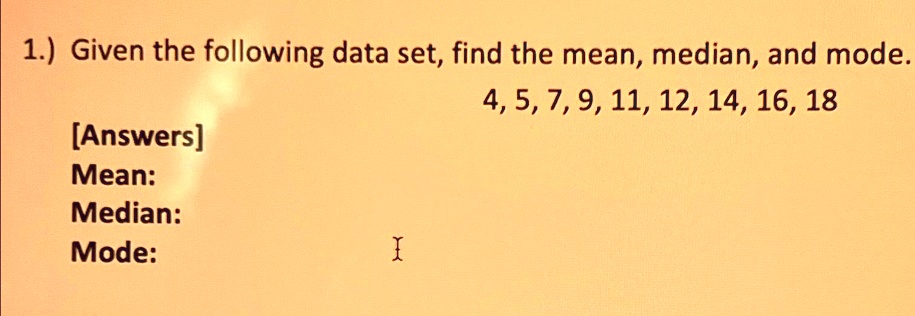
1.) Given the following data set, find the mean, median, and mode. 4, 5, 7, 9, 11, 12, 14, 16, 18 [Answers] Mean: Median: Mode: