Texts:
2. Electrical Properties of Metals
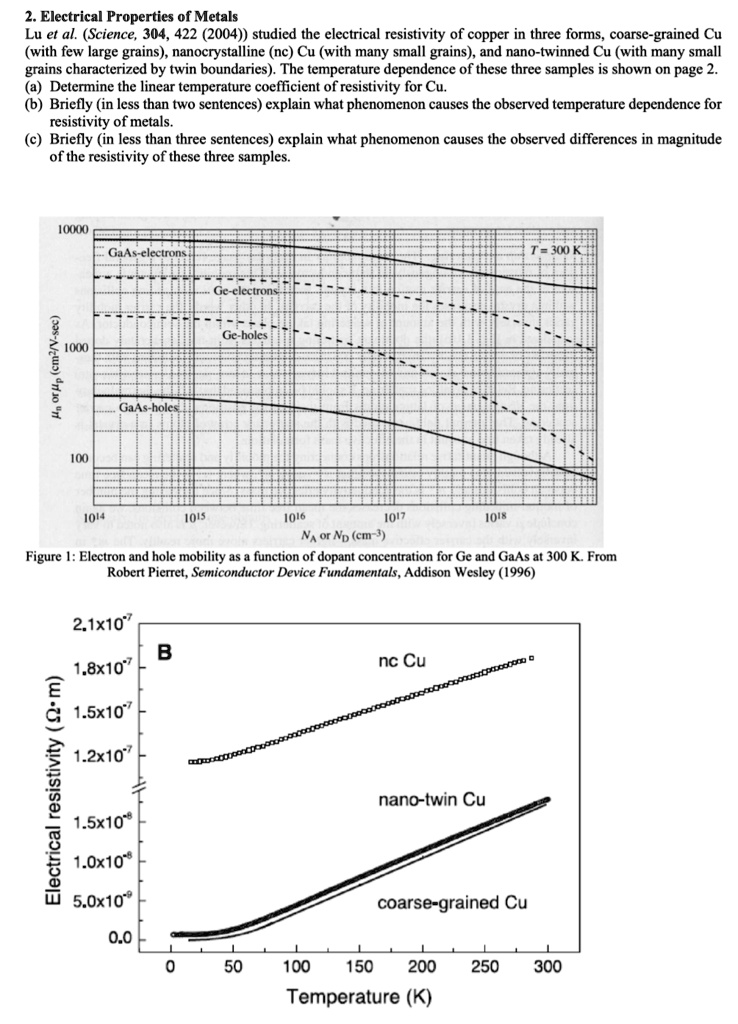
Lu et al. (Science, 304, 422 (2004)) studied the electrical resistivity of copper in three forms: coarse-grained Cu (with few large grains), nanocrystalline (nc) Cu (with many small grains), and nano-twinned Cu (with many small grains characterized by twin boundaries). The temperature dependence of these three samples is shown on page 2.
(a) Determine the linear temperature coefficient of resistivity for Cu.
(b) Briefly (in less than two sentences) explain what phenomenon causes the observed temperature dependence for resistivity of metals.
(c) Briefly (in less than three sentences), explain what phenomenon causes the observed differences in magnitude of the resistivity of these three samples.
10000
GaAs-electron
1000 Ge-hole orp (cm2/V-sec GaAs-holes
100
1014
1015
1016
1017 N or Np (cm-3)
1018
Figure 1: Electron and hole mobility as a function of dopant concentration for Ge and GaAs at 300 K. From Robert Pierret, Semiconductor Device Fundamentals, Addison Wesley (1996)
2.110*7 B 1.8x10⁷ (w. 1.5x10 1.2x10 Electrical resistivity ( 1.510 1.010 5.010 0.0 0
nc Cu
nano-twin Cu
coarse-grained Cu
50
100
150
200
250
300
Temperature (K)