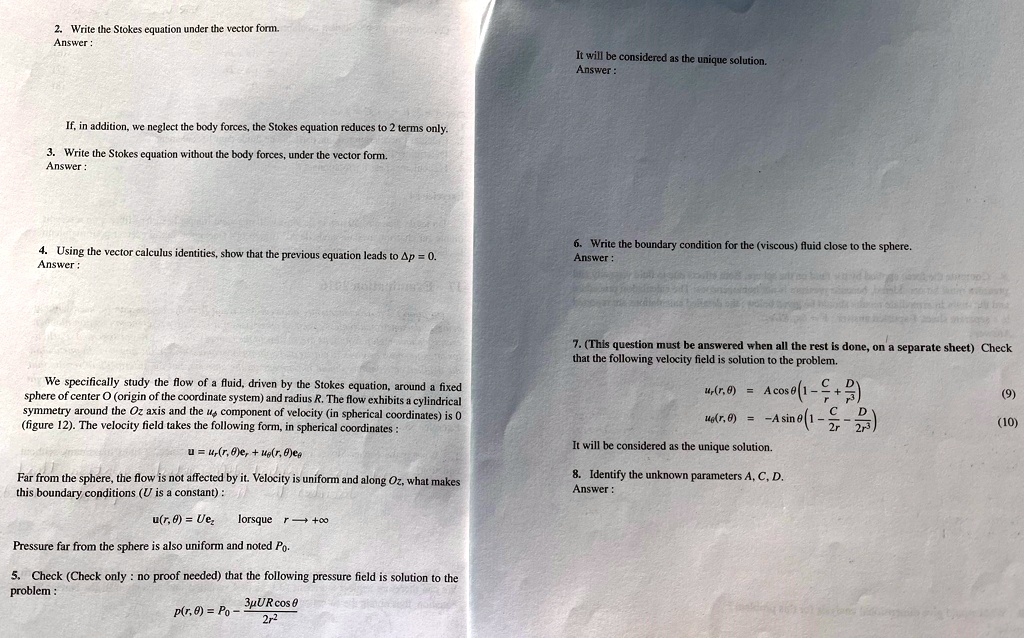
2. Write the Stokes equation under the vector form.
Answer:
If, in addition, we neglect the body forces, the Stokes equation reduces to 2 terms only.
3. Write the Stokes equation without the body forces, under the vector form.
Answer:
It will be considered as the unique solution.
Answer:
4. Using the vector calculus identities, show that the previous equation leads to \(\Delta p = 0\).
Answer:
6. Write the boundary condition for the (viscous) fluid close to the sphere.
Answer:
We specifically study the flow of a fluid, driven by the Stokes equation, around a fixed
sphere of center O (origin of the coordinate system) and radius R. The flow exhibits a cylindrical
symmetry around the Oz axis and the \(u_\theta\) component of velocity (in spherical coordinates) is 0
(figure 12). The velocity field takes the following form, in spherical coordinates:
\(\mathbf{u} = u_r(r, \theta)\mathbf{e}_r + u_\theta(r, \theta)\mathbf{e}_\theta\)
Far from the sphere, the flow is not affected by it. Velocity is uniform and along Oz, what makes
this boundary conditions (U is a constant):
\(\mathbf{u}(r, \theta) = U\mathbf{e}_z\), \text{lorsque } r \to +\infty
Pressure far from the sphere is also uniform and noted \(P_0\).
5. Check (Check only - no proof needed) that the following pressure field is solution to the
problem:
\(p(r, \theta) = P_0 - \frac{3\mu UR \cos\theta}{2r^2}\)
7. (This question must be answered when all the rest is done, on a separate sheet) Check
that the following velocity field is solution to the problem.
\(u_r(r, \theta) = A \cos\theta \left(1 - \frac{C}{r} + \frac{D}{r^3}\right)\)
\(u_\theta(r, \theta) = -A \sin\theta \left(1 - \frac{C}{2r} - \frac{D}{2r^3}\right)\)
It will be considered as the unique solution.
8. Identify the unknown parameters A, C, D.
Answer: