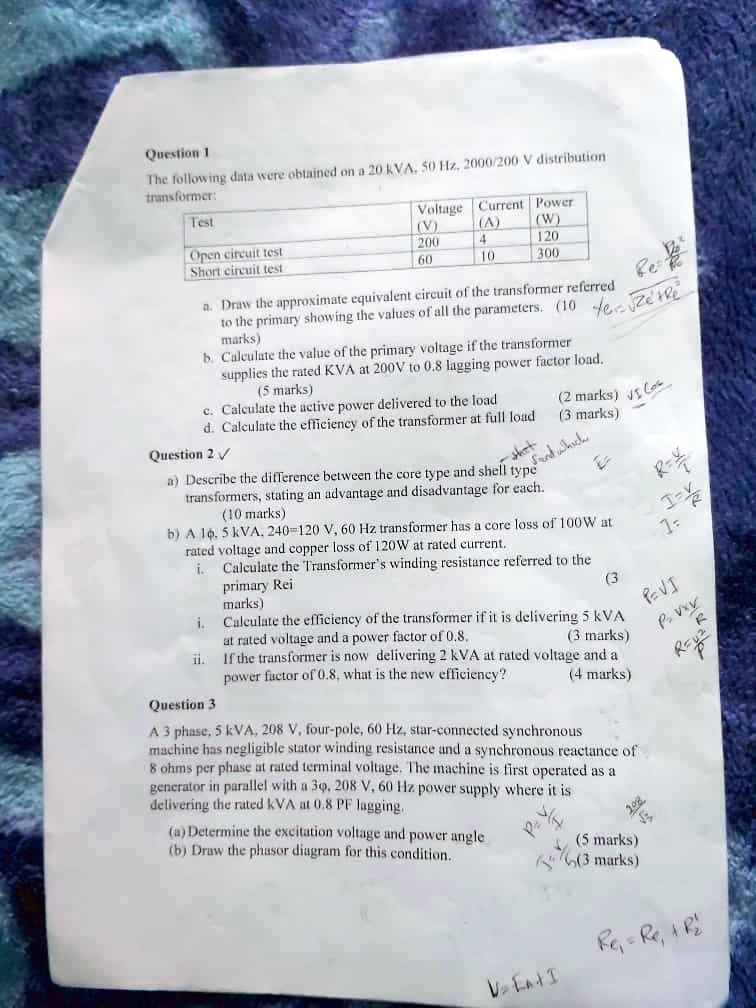
Question 1
The following data were obtained on a 20 kVA, 50 Hz, 2000/200 V distribution
transformer:
Test
Open circuit test
Short circuit test
Voltage
(V)
200
60
Current
(A)
4
10
Power
(W)
120
300
a. Draw the approximate equivalent circuit of the transformer referred
to the primary showing the values of all the parameters. (10 marks)
b. Calculate the value of the primary voltage if the transformer
supplies the rated KVA at 200V to 0.8 lagging power factor load.
(5 marks)
c. Calculate the active power delivered to the load (2 marks)
d. Calculate the efficiency of the transformer at full load (3 marks)
Question 2
a) Describe the difference between the core type and shell type
transformers, stating an advantage and disadvantage for each.
(10 marks)
b) A 1$\phi$, 5 kVA, 240-120 V, 60 Hz transformer has a core loss of 100W at
rated voltage and copper loss of 120W at rated current.
i. Calculate the Transformer's winding resistance referred to the
primary ${R}_{ei}$ (3 marks)
ii. Calculate the efficiency of the transformer if it is delivering 5 kVA
at rated voltage and a power factor of 0.8. (3 marks)
iii. If the transformer is now delivering 2 kVA at rated voltage and a
power factor of 0.8, what is the new efficiency? (4 marks)
Question 3
A 3 phase, 5 kVA, 208 V, four-pole, 60 Hz, star-connected synchronous
machine has negligible stator winding resistance and a synchronous reactance of
8 ohms per phase at rated terminal voltage. The machine is first operated as a
generator in parallel with a 3$\phi$, 208 V, 60 Hz power supply where it is
delivering the rated kVA at 0.8 PF lagging.
(a) Determine the excitation voltage and power angle (5 marks)
(b) Draw the phasor diagram for this condition. (3 marks)