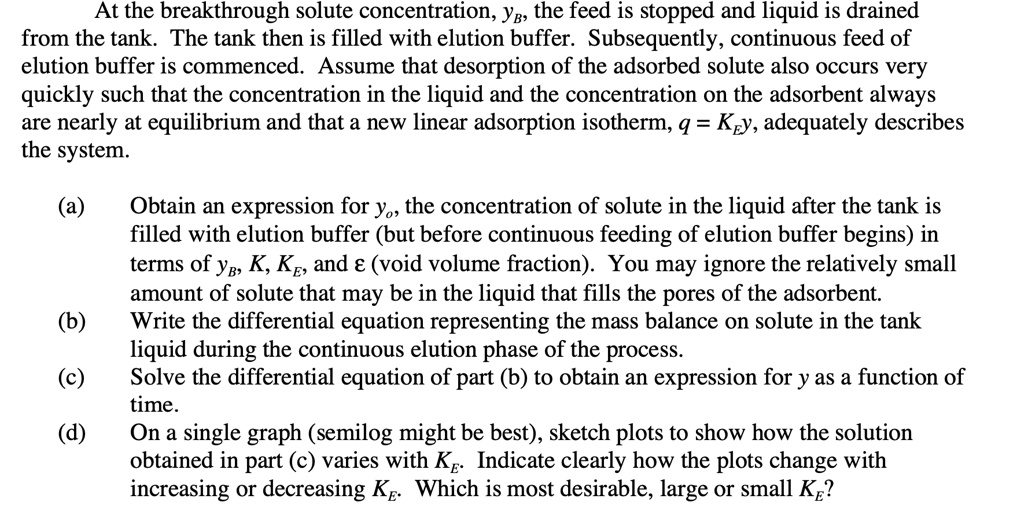
At the breakthrough solute concentration, yB, the feed is stopped and liquid is drained from the tank. The tank then is filled with elution buffer. Subsequently, continuous feed of elution buffer is commenced. Assume that desorption of the adsorbed solute also occurs very quickly such that the concentration in the liquid and the concentration on the adsorbent always are nearly at equilibrium and that a new linear adsorption isotherm, $q = K_Ey$, adequately describes the system.
(a) Obtain an expression for $y_0$, the concentration of solute in the liquid after the tank is filled with elution buffer (but before continuous feeding of elution buffer begins) in terms of $y_B$, $K$, $K_E$, and $\varepsilon$ (void volume fraction). You may ignore the relatively small amount of solute that may be in the liquid that fills the pores of the adsorbent.
(b) Write the differential equation representing the mass balance on solute in the tank liquid during the continuous elution phase of the process.
(c) Solve the differential equation of part (b) to obtain an expression for y as a function of time.
(d) On a single graph (semilog might be best), sketch plots to show how the solution obtained in part (c) varies with $K_E$. Indicate clearly how the plots change with increasing or decreasing $K_E$. Which is most desirable, large or small $K_E$?