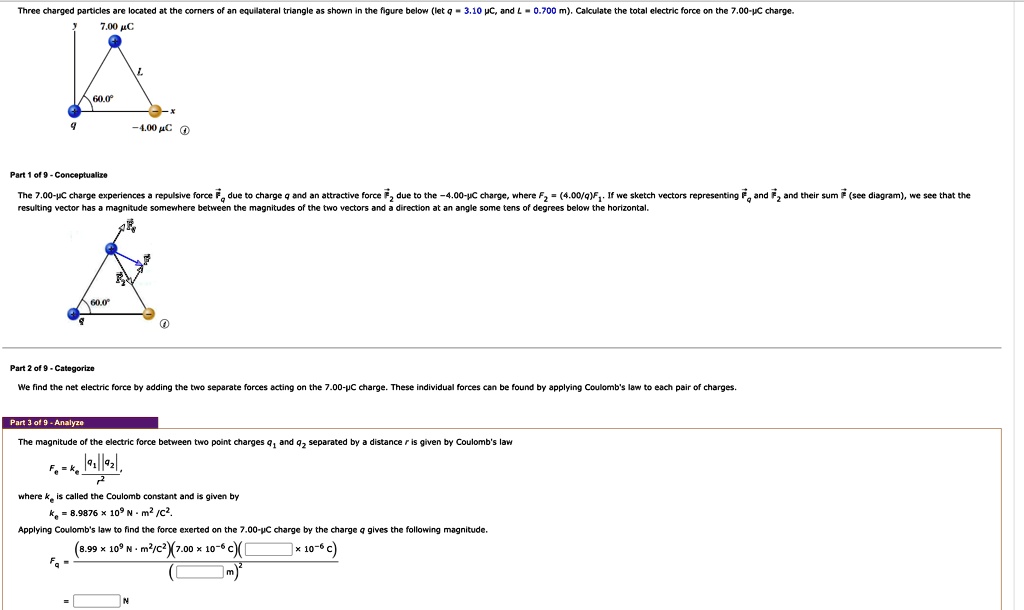
Three charged particles are located at the corners of an equilateral triangle as shown in the figure below (let q = 3.10 µC, and L = 0.700 m). Calculate the total electric force on the 7.00-µC charge.
7.00 µC
60.0°
-4.00 µC
Part 1 of 9 - Conceptualize
The 7.00-µC charge experiences a repulsive force $\vec{F_q}$ due to charge q and an attractive force $\vec{F_2}$ due to the -4.00-µC charge, where $F_2 = (4.00/q)F_1$. If we sketch vectors representing $\vec{F_q}$ and $\vec{F_2}$ and their sum $\vec{F}$ (see diagram), we see that the resulting vector has a magnitude somewhere between the magnitudes of the two vectors and a direction at an angle some tens of degrees below the horizontal.
Part 2 of 9 - Categorize
We find the net electric force by adding the two separate forces acting on the 7.00-µC charge. These individual forces can be found by applying Coulomb's law to each pair of charges.
Part 3 of 9 - Analyze
The magnitude of the electric force between two point charges $q_1$ and $q_2$ separated by a distance r is given by Coulomb's law
$F_e = k_e \frac{|q_1||q_2|}{r^2}$,
where $k_e$ is called the Coulomb constant and is given by
$k_e = 8.9876 \times 10^9 N \cdot m^2/C^2$.
Applying Coulomb's law to find the force exerted on the 7.00-µC charge by the charge q gives the following magnitude.
$F_q = \frac{(8.99 \times 10^9 N \cdot m^2/C^2)(7.00 \times 10^{-6} C)(\boxed{3.10} \times 10^{-6} C)}{(\boxed{0.700} m)^2}$
= $\boxed{0.400} N$