Ace - AI Tutor
Ask Our Educators
Textbooks
My Library
Flashcards
Scribe - AI Notes
Notes & Exams
Download App
jason barbero

jason b.

Divider

Questions asked

BEST MATCH

Do you think Dr. Smith is in pain? Yes, because the brain is sensitive to pain. Yes, because the dura is sensitive to pain. No, because neither of these structures are innervated.

View Answer
divider
BEST MATCH

Heterocyclic aromatic reactivity. (8) Explain why pyridine undergoes substitution at the 3 position more readily than either the 2 or the 4 position

View Answer
divider
BEST MATCH

The following substances enter cells by receptor-mediated endocytosis. liquids containing protein or fatcholesterol and ironNa+ and Cl- ionsglucose and amino acids

View Answer
divider
BEST MATCH

Which of the following offers the least security to the investor? a. Treasury bonds b. Preferred stock c. Corporate bonds d. All are equally risky

View Answer
divider
BEST MATCH

In the long-run, when will a competitive firm enter the market? When price is greater than average total cost When price is less than average total cost When price is greater than marginal cost When price is less than marginal cost

View Answer
divider
BEST MATCH

A developing country adopts a supply-side economic model, emphasizing policies that increase production and supply, such as tax cuts for businesses, deregulation, and incentives for investment. The theory behind this model is that boosting supply will lead to economic growth and job creation. In this scenario, the adoption of supply-side economics primarily aims to: A) Increase consumer demand and government spending B) Stimulate production and economic growth C) Implement strict regulatory controls D) Focus on short-term fiscal measures

View Answer
divider
BEST MATCH

4 points Save Answer Which country is experiencing a simultaneous population stagnation as well as increasing its global business and land investments to the point where other national governments are now increasingly focusing on decreasing this country's foreign footprint? O Chile Chad . O China O Czech Republic

View Answer
divider
BEST MATCH

Problem 5: An ideal gas is confined to a cylindrical, adiabatic chamber fitted with a frictionless piston of mass M (see figure). Initially, the piston is positioned at a height h above the bottom of the cylinder. Adiabatic walls and piston External pressure R $P_0$ M g Ideal gas (a) If the external air pressure is $P_0$, determine the pressure $P_{EQ}$ of the gas in the cylinder. (b) The piston is now moved upwards by an amount y relative to its equilibrium position h and then released. Show that the subsequent displacement is governed by the equation $\ddot{y} + \left(\frac{P_0 \pi R^2}{M} + g\right)\left(1 - \frac{h}{h+y}\right) = 0$ (c) For small displacements such that $|y/h| << 1$, show that the motion is harmonic and derive an expression for the angular frequency $\omega$.

View Answer
divider
BEST MATCH

Consider a particle in the electromagnetic field and find the change of probability current with respect to a free particle?

View Answer
divider
BEST MATCH

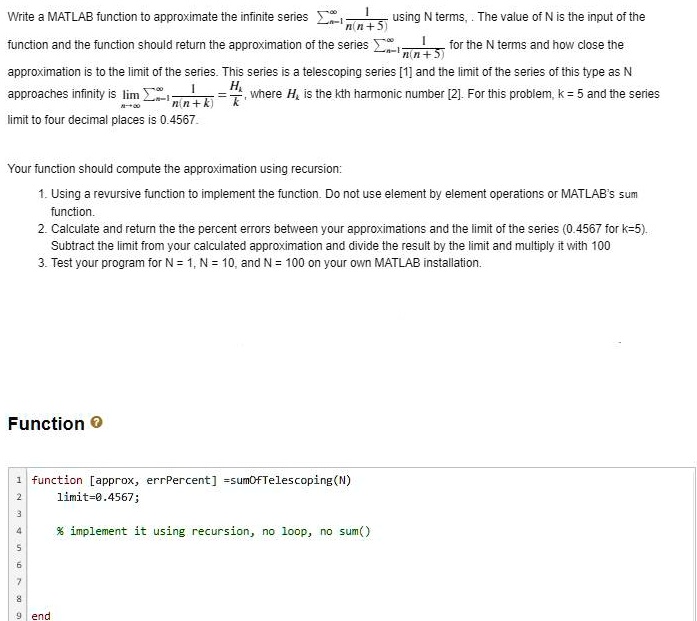
Write a MATLAB function to approximate the infinite series \sum_{n=1}^{\infty} \frac{1}{n(n+5)} using N terms,. The value of N is the input of the function and the function should return the approximation of the series \sum_{n=1}^{\infty} \frac{1}{n(n+5)} for the N terms and how close the approximation is to the limit of the series. This series is a telescoping series [1] and the limit of the series of this type as N approaches infinity is \lim_{N \to \infty} \sum_{n=1}^{N} \frac{1}{n(n+k)} = \frac{H_k}{k}, where $H_k$ is the kth harmonic number [2]. For this problem, k = 5 and the series limit to four decimal places is 0.4567. Your function should compute the approximation using recursion: 1. Using a revursive function to implement the function. Do not use element by element operations or MATLAB's sum function. 2. Calculate and return the the percent errors between your approximations and the limit of the series (0.4567 for k=5). Subtract the limit from your calculated approximation and divide the result by the limit and multiply it with 100 3. Test your program for N = 1, N = 10, and N = 100 on your own MATLAB installation. Function 1 function [approx, errPercent] =sumOfTelescoping(N) 2 limit=0.4567; 3 % implement it using recursion, no loop, no sum() 4 5 6 7 8 end
View Answer
divider