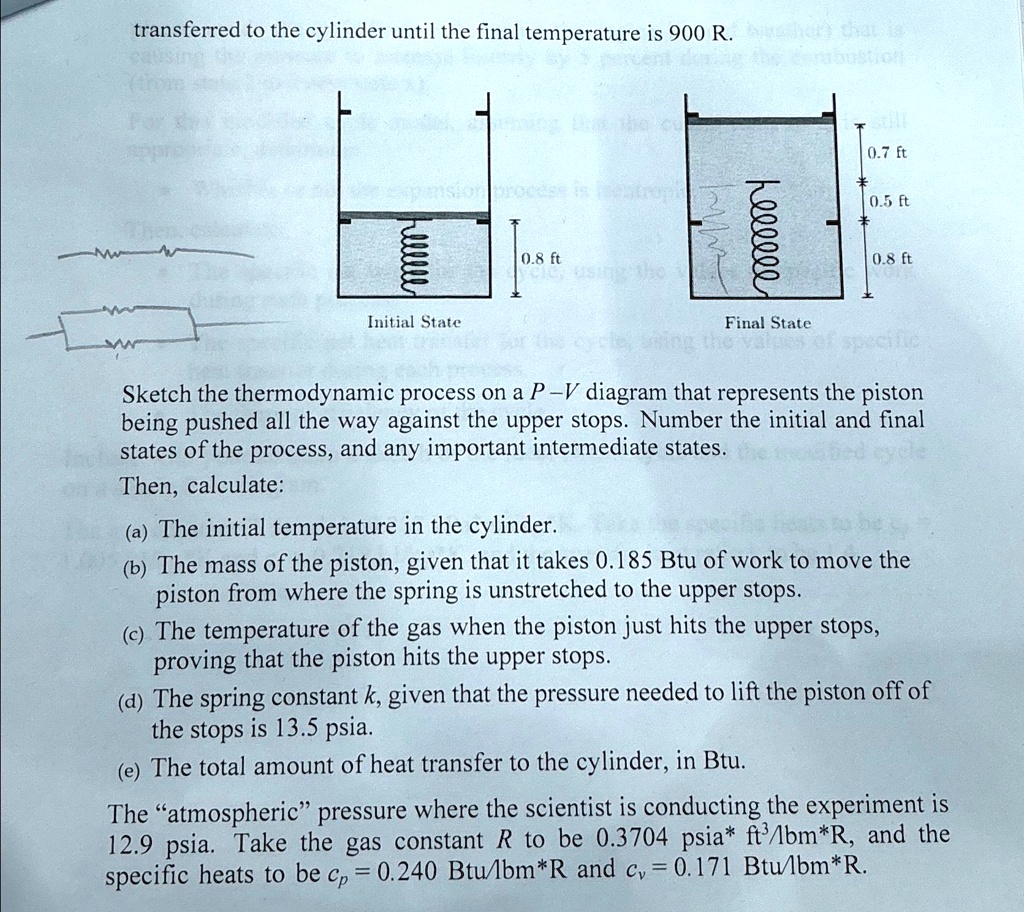
(38 points) A scientist is conducting an experiment with a piston-cylinderspring device in a scientific module, where the gravity is just 12.18f(t)/(s^(2)). The cylinder contains 0.01lbm of gas initially at 10 psia. The piston, with a crosssectional area of 0.1ft^(2), rests on a set of stops and a linear spring. Heat transferred to the cylinder until the final temperature is 900R.
transferred to the cylinder until the final temperature is 900R.
Sketch the thermodynamic process on a P-V diagram that represents the piston being pushed all the way against the upper stops. Number the initial and final states of the process, and any important intermediate states.
Then, calculate:
(a) The initial temperature in the cylinder.
(b) The mass of the piston, given that it takes 0.185 Btu of work to move the piston from where the spring is unstretched to the upper stops.
(c) The temperature of the gas when the piston just hits the upper stops, proving that the piston hits the upper stops.
(d) The spring constant k, given that the pressure needed to lift the piston off of the stops is 13.5 psia.
(e) The total amount of heat transfer to the cylinder, in Btu.
The "atmospheric" pressure where the scientist is conducting the experiment is 12.9 psia. Take the gas constant R to be 0.3704 psia* f(t^(3))/(b)m**R, and the specific heats to be c_(p)=0.240Bt(u)/(b)m**R and c_(v)=0.171Bt(u)/(b)m**R.
transferred to the cylinder until the final temperature is 900 R.
0.7 ft
0.5ft 000000 0.8ft
0.8ft
Initial State
Final State
Sketch the thermodynamic process on a P-V diagram that represents the piston being pushed all the way against the upper stops. Number the initial and final states of the process, and any important intermediate states.
Then,calculate:
(a) The initial temperature in the cylinder. (b) The mass of the piston, given that it takes 0.185 Btu of work to move the piston from where the spring is unstretched to the upper stops. (c). The temperature of the gas when the piston just hits the upper stops, proving that the piston hits the upper stops. (d) The spring constant k, given that the pressure needed to lift the piston off of the stops is 13.5 psia. (e) The total amount of heat transfer to the cylinder, in Btu. The"atmospheric"pressure where the scientist is conducting the experiment is 12.9 psia. Take the gas constant R to be 0.3704 psia* ft/bm*R,and the specific heats to be cp=0.240 Btu/bm*R and c,=0.171 Btu/lbm*R